Teams, players, and broadcasters have argued about natural versus artificial turf for decades. Discussion is typically around the same three things: how it feels, how it impacts the game, and, perhaps most urgently, player safety. Across professional sports, growing scrutiny around injury risk and long-term athlete performance has increased pressure on leagues and venue operators to reconsider synthetic playing surfaces. For sports organizations investing heavily in elite athletes, the field has become an important factor in whether a multi-million dollar player stays healthy through the season.
As a trend toward natural turf begins to emerge, so too does the need for a much larger, more complex engineering conversation.
Natural grass is not just a different surface material. It fundamentally changes how a stadium must function.
For stadium engineers, designers, owners, and operators the return to natural turf introduces new environmental, mechanical, structural, and operational demands that many modern venues were never designed to support. The challenge is no longer just about installing grass. It is about understanding how airflow, solar exposure, thermal loads, irrigation, roof systems, and building geometry interact to keep a living surface alive inside highly engineered entertainment venues.
That reality has become increasingly visible as preparations for the 2026 FIFA World Cup accelerate. Per FIFA mandates, all tournament matches will be played on natural grass or hybrid turf systems. Eight of the selected stadiums normally use artificial turf, and five are enclosed or partially enclosed NFL facilities built for multi-event programming. Not for sustaining a living biological system at field level.
The result is a new set of engineering challenges that extend far beyond the playing surface itself.
Modern Stadiums Are Designed for Spectators, Not Living Fields
Over the past two decades, stadium architecture has evolved dramatically. Venues are no longer designed solely for sports. They are entertainment destinations capable of hosting concerts, large-scale events, immersive fan experiences, and year-round programming.
That evolution has produced larger roof structures, deeper seating bowls, expanded canopies, enclosed façades, and increasingly sophisticated climate control systems. While these features improve the spectator’s experience and operational flexibility, they can create major challenges for natural turf performance.
Once natural turf enters the equation, airflow patterns, solar penetration, humidity management, thermal behavior, and water movement become directly tied to field performance. Decisions traditionally associated with architecture, mechanical systems, façade design, or roof geometry suddenly influence the quality and longevity of the playing surface.
For engineering teams, that creates a far more complex performance question than simply whether grass can survive inside the venue. The real question is whether the entire environmental system of the stadium can consistently support a healthy, high-performance field.
Natural Turf Turns the Field into a Building Performance System
Artificial turf functions largely as a passive surface. Natural grass, on the other hand, behaves more like a living environmental system. That distinction changes the engineering conversation immediately.
This is where climate and performance engineering becomes central to the conversation.
Healthy turf depends on three critical environmental conditions:
- Water (Irrigation systems)
- Wind (Air movement)
- Sun (Photosynthetically Active Radiation)
For stadium designers, understanding airflow across the pitch is particularly important. Large seating bowls, overhanging structures, and enclosed or partially enclosed architectural features can create stagnant air zones. Reduced air movement can contribute to excessive moisture retention, inconsistent growth patterns, turf disease, and surface deterioration. Computational airflow analysis can help identify these areas before construction or retrofit decisions are finalized.
Similarly, solar studies now extend beyond spectator comfort and glare control. While irrigation and air movement are important considerations, perhaps surprisingly, Photosynthetically Active Radiation (PAR) is probably the most complicated of the three factors to address. PAR refers to the specific wavelengths within the solar spectrum that drive photosynthesis and healthy growth of natural turf. Turf specialists measure PAR availability in terms of Daily Light Integral (DLI) which refers to the cumulative photosynthetically active light a surface receives over a full day. For example, cool-season grasses typically need a minimum DLI of around 10 to 15 mol/m²/day for basic survival; high-performance natural turf under competitive play generally benefits from 20 or above.
Designers must understand how much usable PAR radiation reaches the field throughout the day and across different seasons. In some cases, a roof or façade system may allow visible light into the venue while still limiting the wavelengths necessary for healthy turf growth. In enclosed or partially enclosed venues, those thresholds can’t be assumed from general light level estimates. Measuring and modeling DLI across the full pitch area is increasingly treated as a baseline requirement for any serious turf viability assessment, and this can impact decisions around both design and choice of building materials. For example, roof glazing and translucent facade panels that look clear to the eye may only transmit a fraction of usable PAR because of the glass or polycarbonate type and whether UV or IR filtering coatings are applied.
The challenge becomes even more complicated in multi-use venues where operational demands often compete with turf requirements. For example, a stadium may need to remain enclosed for climate control, concerts, acoustics, or weather protection, while the field simultaneously requires sunlight exposure and airflow. The operational schedule of the building itself can begin to conflict with the biological needs of the turf.
These issues are not new. Stadium operators and turf specialists have been navigating them for decades. However, the scale and visibility of the 2026 FIFA World Cup has brought them to the forefront because several venues must now retrofit or temporarily adapt facilities that were never intended to support natural grass to meet World Cup standards.
As a result, natural turf performance increasingly depends on how well venue systems work together as an integrated ecosystem.
FIFA Retrofits Highlight the Limits of Temporary Solutions
As noted above, eight of the 16 World Cup venues typically use artificial turf. Rather than converting permanently, each will install a temporary hybrid system (a combination of natural and synthetic turf) for the eight-week tournament before returning to their original surface. Keeping that grass alive and healthy could require:
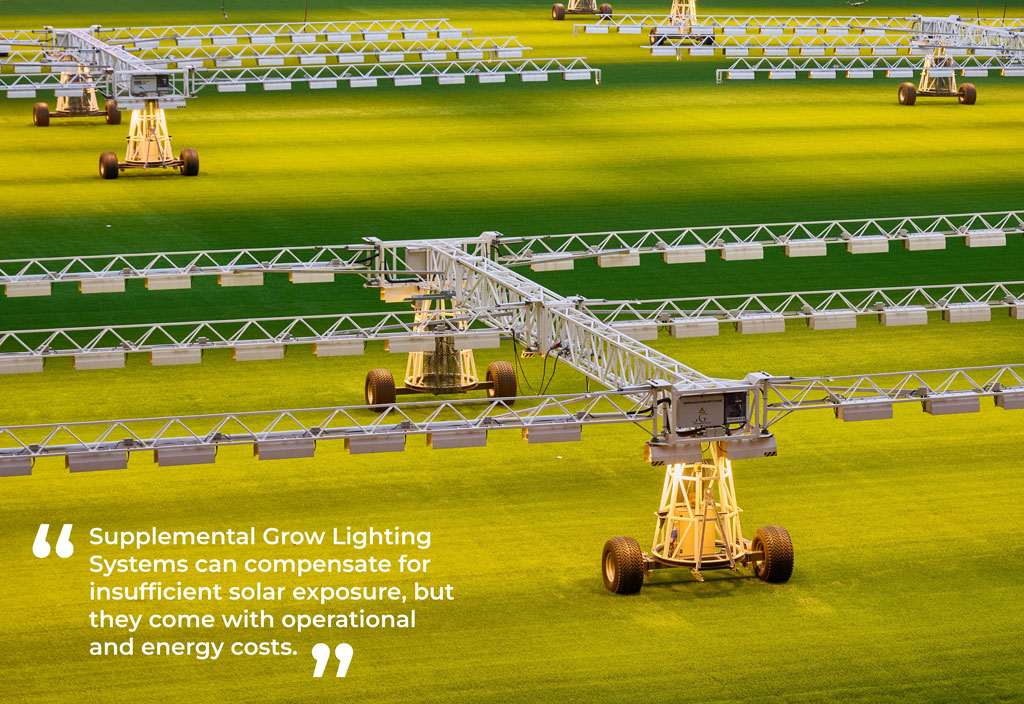
- Supplemental grow lighting systems
- Temporary ventilation or fan systems
- Elevated or modular pitch systems
- Short-term operational changes to roof configurations
While these measures will help venues meet FIFA tournament requirements, they also reveal the limitations of retrofitting buildings that were optimized for different priorities.
Grow lights, for example, can compensate for insufficient solar exposure, but they come with operational and energy costs. Similarly, temporary airflow systems may improve conditions in problem areas, but not every portion of the field requires the same level of intervention.
This creates an opportunity for performance-based analysis.
Rather than overinvesting in broad temporary measures, stadium operators can use environmental modeling to identify precisely where airflow deficiencies, PAR limitations, or thermal challenges exist. In some cases, only certain sections of the field may require supplemental systems.
That level of analysis can significantly influence capital spending decisions, operational planning, and long-term retrofit strategy. At the Paul Biya (Olembe) Omnisports Stadium in Cameroon, for example, refined computational modeling of turf-level solar radiation was central to optimizing the stadium’s cladding and microclimate design. This kind of integrated approach is becoming a baseline expectation in high-performance venue design. It also raises an important question. Could these temporary adaptations become previews of future stadium design standards?
The Return to Natural Turf Is Expanding Beyond Soccer
While FIFA is accelerating the conversation, the shift toward natural turf is not isolated to international soccer.
Across professional sports, venue operators are increasingly balancing entertainment flexibility with athlete performance expectations and long-term player health considerations. As player contracts grow larger and performance investments increase, field conditions become part of broader operational risk management.
That shift is beginning to influence how sports organizations think about venue infrastructure from the earliest stages of design.
Instead of treating natural turf as a retrofit problem, future projects may increasingly evaluate turf viability during early concept development. Questions around roof transparency, airflow corridors, façade openness, mechanical integration, and solar exposure may become foundational design considerations rather than operational afterthoughts.
However, the implications extend beyond the field itself.
For example, maintaining turf health may require keeping roof systems open for longer periods to increase solar exposure. While that benefits the field, it can also increase heat absorption within seating bowls and surrounding materials such as steel, concrete, and plastics.
In many stadium environments, the larger thermal challenge is not cooling the air itself. It is cooling the surfaces that absorb and radiate heat throughout the venue. Seats, structural components, and exposed materials can retain thermal energy long after direct sunlight exposure ends, affecting spectator comfort and operational cooling timelines before events.
As stadium systems become more interconnected, turf performance should also become a key consideration in design just as thermal comfort, energy performance, or operational efficiency are today.
Designing the Next Generation of Stadiums
The broader lesson emerging from FIFA 2026 is that natural turf is no longer just a sports operations issue. It is a climate and performance engineering challenge.
For stadium engineers and designers, that means environmental analysis must increasingly support decisions traditionally viewed through separate lenses:
- Architecture
- Mechanical systems
- Roof design
- Thermal comfort
- Structural performance
- Sustainability
- Venue operations
The most successful future venues may not simply be those that create the loudest atmosphere or the most flexible event calendar. They may be the venues capable of balancing spectator experience, operational efficiency, athlete performance, and biological field requirements simultaneously.
That requires a more integrated design approach.
Climate and performance engineering plays a critical role in that process by helping project teams understand how factors such as airflow, solar exposure, thermal behavior, and environmental conditions are interconnected and need to be considered holistically, across the entire stadium ecosystem.
FIFA 2026 may be the catalyst bringing these challenges into public view, but the underlying shift is likely much larger. As stadiums continue evolving into increasingly complex entertainment environments, the ability to successfully support a living field may become one of the defining engineering challenges of the next generation of sports venue design.