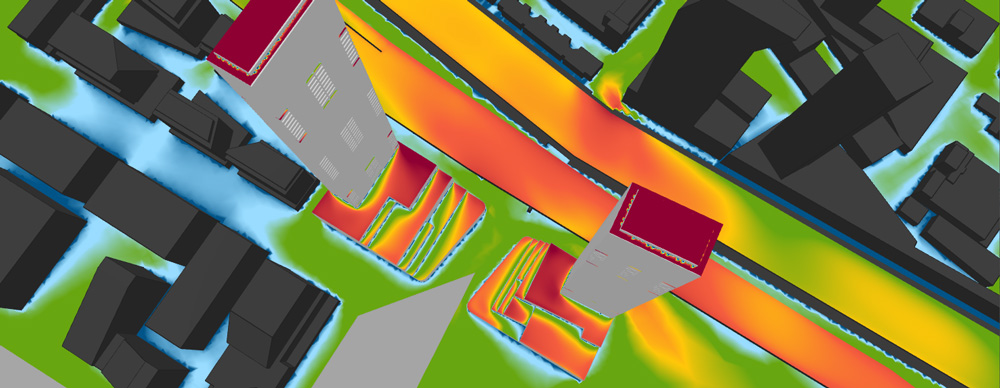
As cities in hot climates grapple with rising temperatures and increasing pressure to design for both comfort and sustainability, the question of how to enhance thermal comfort and safety in outdoor spaces has never been more relevant. At the 2026 ASHRAE Annual Conference in Austin, Texas, RWDI’s Ryan Danks and Dianthé van Weerden presented on exactly this challenge. Ryan’s presentation focused on exploring how thoughtful design can make outdoor environments genuinely comfortable, even in extreme heat, and Dianthé’s focused on best practices for simulating the complex interactions between the built and natural environments.
Ryan Danks is RWDI’s Practice Area Leader for Building Performance, Ventilation & CFD, with deep expertise in the intersection of building physics, microclimate design, and human comfort.
Dianthé van Weerden is a Senior Engineer in RWDI’s Building Performance team who has extensive experience in simulating the movement of air and heat across a range of scales. We spoke with them to get the key takeaways from these sessions.
Q: Why is outdoor thermal comfort such an important topic right now?
Ryan: It’s really a result of a lot of different things coming together at one time. For one, climate change is making heat events more frequent and more severe. If we look at the year alone we’ve had a high heat event in late January in Argentina and Australia. In March a heat wave struck southwestern and central United States and this past may Europe and UK experienced significant heat events. This is on top of other recent extreme heat events in traditionally “temperate” locations like Australia and North America, never mind the worsening conditions in India, the Middle East, southeast Asia and other traditionally “hot” climates. At the same time, there’s growing recognition that the quality of outdoor spaces directly affects public health, community livability, and how people engage with the built environment. Planning departments and the general public are becoming much more sophisticated in what they expect, and they’re asking harder questions about how a building or development will shape the microclimate around it. Add to that the push toward net zero carbon, and you have a strong motivation to solve outdoor comfort problems with low- and zero-energy strategies, rather than reaching immediately for mechanical cooling.
Q: What are the key factors that actually drive thermal comfort outdoors?
Dianthé: It’s a combination of environmental and physiological variables. Solar radiation is the dominant factor during warmer times of year in many places. Direct sun exposure, will make a space feel dramatically hotter than air temperature alone would suggest. Wind plays a dual role: airflow can provide meaningful cooling through convection and evaporation, but under very high temperatures it can be a detriment – the so-called ‘hairdryer effect’.
Ryan: Then there are surface temperatures, the materials around and underfoot absorb and re-radiate heat, which significantly affects the mean radiant temperature that a person experiences. Humidity matters too, high humidities make our body’s natural cooling system (sweating) as well as some artificial cooling approaches (evaporative cooling, fans) much less effective. Understanding how all of these interact in a specific space is the foundation of good outdoor comfort design.
Q: What design strategies are most effective for enhancing comfort in hot climates?
Ryan: There are many approaches that can be used but we always want to start with passive approaches – strategies that don’t require energy or water to promote comfort. For example, landscaping, built canopies, or careful building massing that casts shade at the right times of day, reducing direct solar exposure has a huge impact. Vegetation also does double duty, it provides shade while also cooling the surrounding air through evapotranspiration, which is something hard surfaces can’t do.
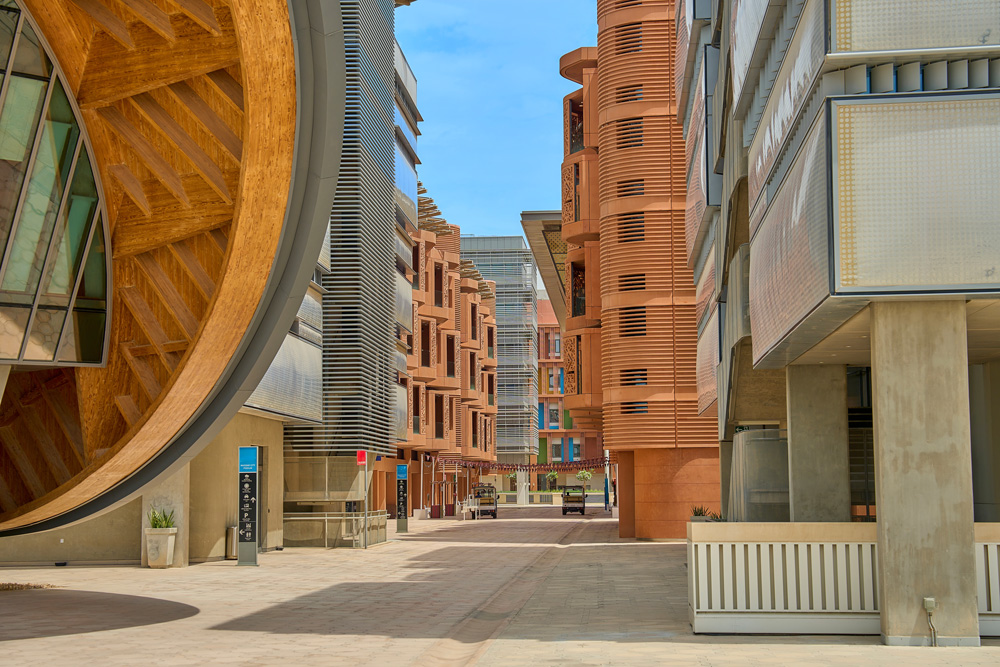
Dianthé: We can also passively control wind. Orienting spaces and using design elements to channel prevailing breezes through outdoor areas can dramatically improve perceived comfort, especially when combined with shade. Material selection matters too, high-albedo and low heat-capacity surfaces stay cooler and reduce the radiant heat load on occupants.
For spaces where passive measures alone can’t achieve comfort goals there are active measures like exhaust air systems and localized misting or cooling features that can be deployed on an as-needed basis to deal with the most extreme conditions. These work best when the passive groundwork has already been done to prevent the active measures being diluted by warm winds.
Q: Do active cooling measures, like fans and evaporative cooling, work or should they be avoided?
Dianthé: Active measures definitely have their place, but they should not (and often cannot) be used as a band-aid solution to compensate for less-than-ideal decisions made earlier in the design process. For active cooling measures to be most effective, they need to be coupled with a level of control over things like wind and sun (e.g. controlling hot wind infiltration, providing shading, etc.). Otherwise, you will get limited return on your energy investment. This means some level of passive design needs to occur regardless. Also, while in some cases the active solution may be easier up front, the energy burden is far greater – especially when you consider it over the lifespan of the project which could make achieving energy use goals (required or otherwise) challenging. Active measures are best applied to targeted situations.
Q: How are heat resilience and climate adaptation changing the way designers need to think about this?
Ryan: We know that heat waves are likely to become more intense and more frequent. This means extreme heat events are no longer edge cases to be planned around; they’re conditions that need to be designed for. Many cities have appointed ‘heat czars’ and are updating design guidance for new buildings to emphasize outdoor comfort. Cities like London and Toronto have gone as far as to require proposed projects to use simulation to predict the impact of new projects on the existing thermal comfort conditions.
To be clear the goal isn’t to create indoor-like conditions outside 100% of the time, but the bar is being raised for buildings. They need to avoid negative impacts at a minimum and ideally improve the outdoor environment around them. Developers and architects need to understand the influence of their buildings in an increasingly sophisticated way, which requires a more holistic, integrated approach to design starting from Day 1.
Q: What is the number one takeaway from your presentation?
Ryan: That the knowledge to create outdoor environments that can respond to, and mitigate, high heat conditions already exist, and often aren’t energy intensive. Shade, vegetation, smart material choices, and good wind management can do the heavy lifting in many situations. The challenge isn’t a lack of solutions; it’s making sure those solutions are integrated into the design process early enough to be effective. Once you’re value-engineering out the landscaping or simplifying the massing late in a project, you’ve already lost the most powerful levers you had. The commitment to thoughtful, holistic design has to come at the beginning.
Dianthé: Computational simulations, such as computational fluid dynamics for wind or solar simulations to look at insolation, can be used to evaluate these comfort strategies during early-design. Results from these simulations can be combined with either historical climate data or predictions of future conditions to get a wider view of comfort conditions throughout the year and at various times of day. These types of simulations have, among other things, allowed us to evaluate the efficacy of traditional wind towers in the middle east, helped strategically shape and orient canopies to provide shade while also channeling light breezes into pedestrian areas and optimize the placement of active cooling measures for efficient and impactful operation. Combing the knowledge that goes into creating comfortable outdoor environments with the predictive power of modern simulation tools allows for exciting and innovative designs for these spaces.