Reduced computational costs, increased access to cloud computing, and improvements in simulation technology are making computational wind engineering (CWE) more accessible across the building industry. As a result, interest in computational methods for wind engineering and performance modelling continues to grow among developers, architects, engineers, and consultants looking for greater flexibility and deeper insight during design.
But as adoption accelerates, the industry is facing an important question:
How can computational wind engineering be applied consistently and reliably enough to support real-world design decisions?
That question is helping drive the development of an emerging computational wind engineering pre-standard This pre-standard is aimed at establishing a more consistent technical framework for CFD-based wind loading and cladding applications, with the potential to inform broader wind engineering work. RWDI is at the table helping to define what comes next.
Why is a Pre-Standard for CFD important?
As CFD becomes more accessible, the importance of standardized methodology also increases.
While modern CFD software can generate simulation results relatively quickly, producing engineering-grade results requires far more than simply running a model. Reliable computational wind engineering depends heavily on how simulations are set up, including factors such as turbulence modelling, inflow conditions, mesh refinement, computational domain sizing, and post-processing methodologies.
Without consistent technical guidance, different practitioners can produce significantly different outcomes when analyzing the same problem.
That variability is one of the key reasons the industry developed a pre-standard for computational wind engineering, which is set to be published in the coming months.
The goal of the pre-standard is to help establish the same level of rigor, consistency, and confidence for computational methods that already exist today for wind tunnel testing. The evolution of computational wind engineering is not simply about new technology. It is about helping ensure that emerging tools continue to support safe, resilient, and high-performing built environments, backed by rigorous burden of proof requirements and mandatory peer review on every project.
It’s essentially the same process that occurred for wind tunnel modelling when it emerged as a field. At some point the industry had to define what proper wind tunnel testing looked like, the requirements for turbulent boundary layers, domain setup, and instrumentation. What separates a result you can trust from one you can’t. The pre-standard is doing that same work for CWE: prescribing the modelling requirements, boundary conditions, and wind-structure interaction parameters that make results reliable and defensible enough to use directly in design.
Developed by the Structural Engineering Institute (SEI) of ASCE, the Pre–standard for Use of Computational Wind Engineering in Building Design was identified as the #1 priority by participants at a 2022 NIST-sponsored workshop on advancements in CWE.
Having RWDI’s Goncalo Pedro, Director of Product Development, as an author of the emerging pre-standard reflects both our deep experience in wind engineering and our continued investment in computational methods and advanced simulation capabilities.
Why Now?
For years, wind tunnel testing has been the gold standard for advanced wind engineering studies, and while it remains the industry benchmark, the rise of CWE can’t be ignored. Cloud computing has dramatically lowered the cost and time required to run CFD simulations, and as a result more practitioners than ever before are reaching for computational tools as an alternative.
But accessibility doesn’t mean all approaches are equal. A rigorous CWE study, regardless of the tool used, is neither fast nor cheap. Cladding studies for example, require best-in-class methodologies — such as Detached Eddy Simulation or Large Eddy Simulation with appropriate domain sizing and mesh refinement — applied consistently across multiple wind directions. When done properly, the process is inherently time-consuming and computationally costly.
That gap between running a simulation and doing it right is where misconceptions often arise. It’s entirely possible to produce results from a CFD model that look credible but fall short of what rigorous CWE demands. Reputable practitioners understand those standards and apply them consistently, whether the work is done in a wind tunnel or through simulation.
The longer that gap goes unaddressed, the greater the risk that inconsistent, unreliable methodology becomes quietly embedded in how buildings get designed. Which is exactly why the timing of this pre-standard matters. If it’s getting easier to do, now is the time to make sure everyone understands how to do it properly.
Wind Tunnel or CFD
So how do the two methods actually compare in practice?
The time investment for each method sits in different places. Wind tunnel testing front loads its effort. Physically building and instrumenting a scale model takes weeks, but once the model is ready, testing across multiple wind directions is relatively fast. CFD front-loads its effort differently: setup is quicker, all simulations can run in parallel, and depending on the complexity of the project, high-quality results can sometimes be delivered faster than a wind tunnel schedule allows. The pressure to manage computational costs can mean running fewer simulations, but that’s a project management decision, not a limitation of the method itself.
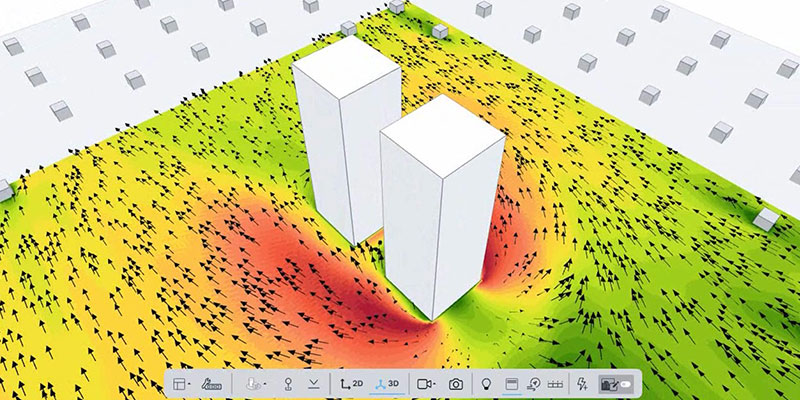
The datasets each method produces are also more equivalent than they might appear. Wind tunnel testing is traditionally limited to measuring at specific instrumented locations. CFD, by contrast, captures flow data everywhere in the model, making it, in many respects, the richer dataset. CFD also preserves faithful geometry where wind tunnel models sometimes have to distort features like balconies to accommodate physical sensors. The clearest practical difference is visualization. CFD makes airflow patterns visible and tangible in three dimensions in a way that complements the analysis.
The likely future isn’t one method replacing the other. It’s both becoming recognized as legitimate, equivalent tools, with the choice between which method to use coming down to the unique demands of the project. And these demands may change as the design progresses from an early concept to detailed design.
The Risk of Getting This Wrong
Without a standard, the concern isn’t just inconsistency; it’s safety. The whole reason codes are prescriptive about wind in the first place is to ensure buildings can withstand what nature throws at them. A CWE methodology that looks credible but isn’t, produces numbers that feel like data but ultimately can’t be relied on.
A well-constructed pre-standard, one that eventually gets adopted into code, doesn’t just protect individual projects. It protects the integrity of discipline and the safety of the buildings that come out of it.
What the Pre-Standard Could Mean for the Industry
The emerging pre-standard represents an important step toward broader consistency in computational wind engineering practices.
As methodologies become more clearly defined, the industry will benefit from:
- greater confidence in computational results
- improved consistency across practitioners
- clearer expectations for analysis quality
- stronger alignment between computational methods and future code pathways
Most importantly, it helps ensure that emerging innovation is supported by technical rigor.
As computational tools become more powerful and more accessible, the industry’s focus is shifting from whether CFD can be used for wind engineering to how it can be used responsibly and reliably.