The explosive growth of AI and high-density computing is pushing data centers to their limits. With rack power densities climbing from 30 to 100 kilowatts and beyond, the ability to output enormous amounts of heat, often within the same building footprint, has become one of the most pressing engineering challenges in the industry. Ensuring optimal performance of the exterior cooling system is no longer optional; it is fundamental to the performance, efficiency, and reliability of a data center.
At the 2026 ASHRAE Annual Conference in Austin, Texas, RWDI’s Vimaldoss Jesud has presented on how high-fidelity computational fluid dynamics (CFD) modeling can be used to better understand and optimize the external airflow environment around data centers. We spoke with him to unpack the key takeaways.
Q: What’s driving the renewed interest in external airflow modeling for data centers?
Vimaldoss: The sheer scale of heat rejection has changed the game. Modern high-density data centers, especially those supporting AI workloads, are generating heat loads that were almost unimaginable a decade ago. Cabinet-level and chip-level liquid cooling technologies are increasingly common, but all of that heat still ultimately has to go somewhere, and it typically gets rejected to the atmosphere through cooling towers and other external equipment. When you have dense layouts of chillers operating with less-than-optimal clearances, exhaust air can potentially recirculate back into intake equipment.
On site electricity generation, which is often a requirement, can exacerbate the situation with hot exhausts which can also impact performance. This makes understanding the site-specific airflow patterns around a facility critically important. A poorly understood external flow environment can directly compromise cooling performance and the reliability of a data center.
Q: How does CFD compare to physical wind tunnel testing for this kind of analysis?
Vimaldoss: CFD is increasingly becoming an essential complement to wind tunnel testing. A wind tunnel study of buoyancy driven flows where there are dozens, if not hundreds, of potential sources and receptors is a non-trivial undertaking. The increasingly common trend of clustering multiple data centers close together complicates this further. During early design, when layouts are still in flux, CFD can more quickly provide actionable early insights into how different layouts may promote or hinder the dilution of hot exhausts.
That said, CFD has its drawbacks as well and it needs expert application and interpretation to make sure the simplifications inherent in it don’t lead you down the wrong path.
Q: What are the main factors that influence external airflow around a data center?
Vimaldoss: There are three primary categories. First, site-specific climatic conditions. Wind speed and direction distributions vary significantly by location and with the air temperature conditions that are of most concern. Annualized wind statistics don’t tell the whole story if the prime concern is during extremely warm days. The differences in wind speeds and directions during those conditions directly affect a designer’s understanding of how air moves around the facility. Second, heat sources and their configuration. The placement and intensity of cooling towers, chillers, and other heat-rejecting equipment shapes the thermal plumes and recirculation patterns around the facility they serve and potentially others than are nearby. Third, the surrounding environment. Local topography and neighbouring structures can dramatically alter the wind flows a data center experiences. A facility in an open rural setting behaves very differently from one in a dense urban environment or on a multi-building campus.
Q: Your presentation focused heavily on turbulence modeling — why does that matter so much?
Vimaldoss: CFD is only as good as its underlying physics, and turbulence is the hardest part of that physics to get right. Werner Heisenberg, one of the founders of quantum mechanics, reportedly said he’d ask God two questions: why relativity, and why turbulence. That gives you a sense of the problem. The choice of turbulence model has a direct bearing on the accuracy and usefulness of results, particularly for data center applications where strong flow separations and complex recirculation patterns are common.
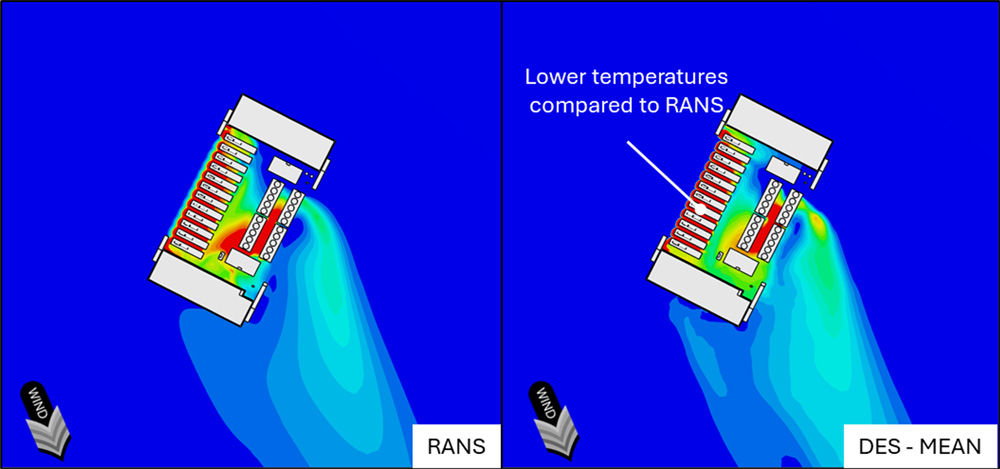
In our work, we compared two principal approaches: Reynolds-Averaged Navier-Stokes (RANS) modeling, which is computationally efficient, and Detached Eddy Simulation (DES), a higher-fidelity hybrid approach that better resolves turbulent flow structures. Understanding when each is appropriate was the primary goal of this work.
Q: What did your case study reveal about when to use each approach?
Vimaldoss: The case study modeled a representative data center using both RANS and DES, examining airspeed and temperature contours around the building as well as cooling tower intake temperatures under different wind directions. RANS resulted in higher intake temperature predictions compared to the DES simulations, because of the better acknowledgement turbulent dispersion in the DES simulations. The DES simulations were also found to be more robust in complex situations such as urban environments or topographic changes. While conservative estimates may be acceptable during early design, the realities of data center design often require a sharper pencil to ensure equipment is not over-specified.
There is also the question of impacts further downwind. The further away from the source the more important turbulent dispersion becomes. Given the growing concerns around so-called data center heat islands, an accurate accounting of the impact of emitted heat from a data center can be crucial to get buy-in from neighboring communities.
Q: What is the number one takeaway from your presentation?
Danks: CFD is a valuable tool in a data center designer’s toolkit, but it cannot be used blindly. A solid understanding of the local climate is needed to ensure the correct conditions are modeled and the choice of turbulence modelling approach must be based on good engineering judgement, not default settings.
RANS is efficient, but for complex sites and configurations, a higher-fidelity approach like DES may be needed. Indeed, in many cases using RANS for initial assessments of near field conditions for quick explorations, and DES to refine layouts and provide higher-fidelity answers can be the best path forward. Though whatever approach is used, it is important to remember that CFD is just a tool that provides predictions. Expertise is needed to interpret these predictions and transform them into actionable insights.