Ontario’s approach to air and noise permitting is changing, and for many facilities, that change is not optional.
When the Environmental Activity and Sector Registry (EASR) regulation (O. Reg. 1/17) came into force in 2017, facilities were given a 10-year window to transition from the Environmental Compliance Approval (ECA) framework. That transition period is now entering its final stretch, with the January 31, 2027 deadline approaching.
If you currently operate under an ECA, you may be required to make that change. And while the registering process for the new framework may be simplified, the support needed for technical and documentation requirements has increased.
This guide breaks down what the EASR Ontario is, who needs to register, what is changing from the ECA framework, and what facilities should be doing now to prepare.
What is the EASR?
The Ontario EASR, short for the Environmental Activity and Sector Registry, is the province’s modernized framework for regulating air and noise emissions.
Instead of going through a lengthy Ministry review process, eligible facilities register for their activities directly through an online system. Approval is immediate, provided all regulatory requirements are met. However, that speed comes with a trade-off.
Under EASR, the responsibility for demonstrating compliance sits with the facility and its engineering team. Supporting studies, including Emission Summary and Dispersion Modelling (ESDM) reports and air acoustics assessments, must be completed in advance and sealed by a licensed Professional Engineer in Ontario.
Essentially, EASR replaces review-based approvals with self-certified compliance.
What EASR Ontario delivers:
- Immediate authorization to operate upon registration
- A standardized, rules-based framework instead of case-by-case approvals
- Greater accountability on operators to ensure technical accuracy and completeness
- Mandatory involvement of a licensed P.Eng
ECA vs. EASR: What is Changing
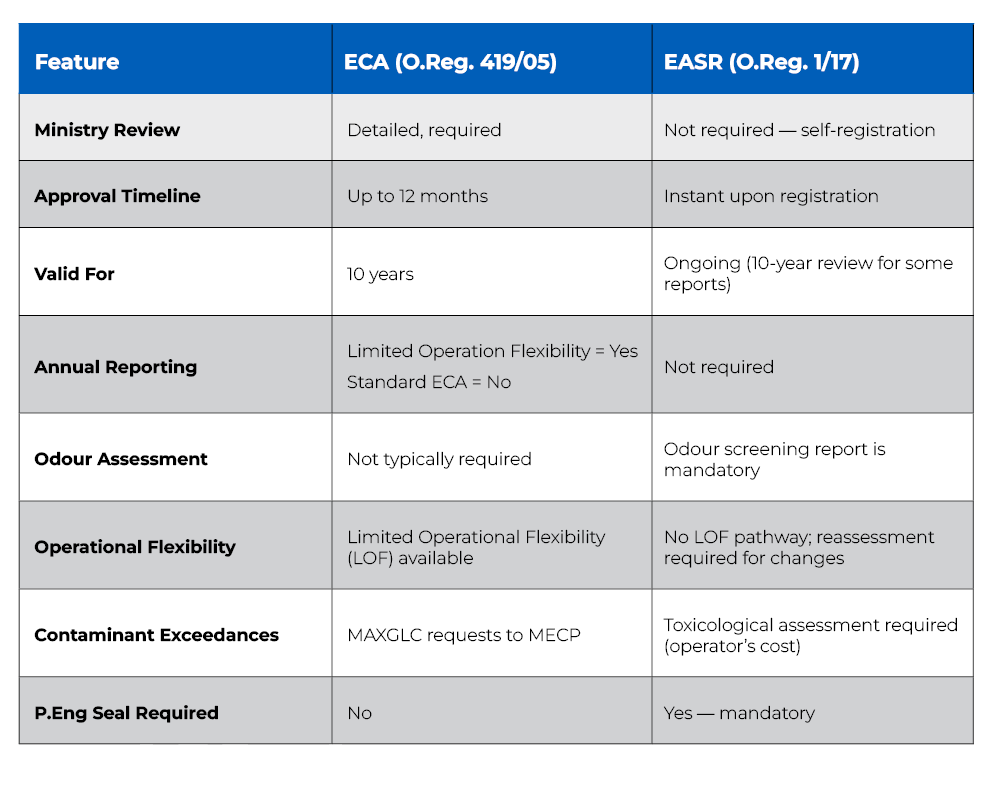
For years, ECAs under O. Reg. 419/05 have been the default pathway for facilities with air and noise emissions. EASR Ontario was introduced to streamline that process for eligible sectors. EASR shifts responsibility directly onto facility operators, with more substantial technical and documentation requirements upfront.
There are also substantive technical and operational differences that facilities need to prepare for. Here’s how the two pathways compare:
Who Is Required to Register?
All Ontario facilities currently operating under an ECA for air and noise that are eligible under O.Reg. 1/17 are required to transition to EASR.
Determining your eligibility comes down to your North American Industrial Classification System (NAICS) code, a standardized classification that describes your facility’s primary industrial activity.
If your NAICS code is not on the exempted list below, or if your facility does not partake in any of the exempted facility activities (also listed below), you are expected to register under EASR.
Your NAICS code should appear in your existing ESDM report or your original ECA application package. If you are still unable to locate your code, you can use Statistics Canada’s NAICS lookup tool or get in touch with a compliance consultant like RWDI.
Exempted NAICS Codes:
The following industrial classifications are not eligible for EASR:
- 2122 — Metal ore mining
- 2123 — Non-metallic mineral mining and quarrying
- 22132 — Sewage treatment facilities
- 31122 — Starch and vegetable fat and oil manufacturing
- 31161 — Animal slaughtering and processing
- 321111 — Sawmills (except shingle and shake mills)
- 3221 — Pulp, paper and paperboard mills
- 32411 — Petroleum refineries
- 32412 — Asphalt paving, roofing and saturated materials manufacturing
- 32419 — Other petroleum and coal product manufacturing
- 325 — Chemical manufacturing
- 32615 — Urethane and other foam product manufacturing
- 3262 — Rubber product manufacturing
- 32731 — Cement manufacturing
- 32732 — Ready-mix concrete manufacturing
- 32741 — Lime manufacturing
- 3279 — Other non-metallic mineral product manufacturing
- 331 — Primary metal manufacturing
- 3321 — Forging and stamping
- 33281 — Coating, engraving, cold and heat treating and allied activities
- 332999 — All other miscellaneous fabricated metal product manufacturing
- 336 — Transportation equipment manufacturing
- 56211 — Waste collection
- 5622 — Waste treatment and disposal
- 5629 — Remediation and other waste management services
- 81222 — Cemeteries and crematoria
Activity-Specific Exemptions:
If any of the following activities occur on-site you are not eligible for EASR:
- Land disposal of waste
- Thermal treatment or disposal of waste (with limited exceptions for small wood-fired combustors installed after January 31, 2017)
- Plating processes involving cadmium, cyanide, chromium, or nickel
- Electrolytic stripping that removes cadmium, chromium, or nickel
- Outdoor processing of metals (torching, shearing, shredding, or plasma cutting) other than routine maintenance
- Operation of an alternative low-carbon fuel site (as defined in O. Reg. 79/15)
- Operation of a fossil-fuel electric power generator ≥ 25 megawatts
- Use of a combustion turbine
- Combustion sources using biogas, biomass, coal, or waste fuel
- Facilities with a landfilling site no longer permitted to accept waste
- Facilities with a site-specific air standard or Technical Standards Registry entry
- Mobile equipment operated across multiple sites
- Activities at facilities on grouped properties as defined under O.Reg. 419/05
- Facilities operating under a Renewable Energy Approval (REA) covering all air and noise activities
How to Register on the Ontario EASR
The EASR registration process is self-directed, but the technical work behind it is substantial. Here is what the process looks like:
Step 1: Confirm Eligibility
Determine your NAICS code and confirm you are within scope of EASR. Review exempt codes and activity-specific exclusions. If there is any ambiguity, resolve it before investing in technical work.
Step 2: Conduct an Emission Summary and Dispersion Modelling (ESDM) Study
The ESDM report quantifies air emissions from all sources at your facility and models their dispersion to assess ground-level concentrations against Ontario’s air quality standards (Table 3 under O.Reg. 419/05). This is the technical backbone of your EASR application.
Step 3: Complete an Air Acoustics Report (AAR)
The AAR assesses noise emissions from your facility and evaluates compliance with applicable noise guidelines. It must account for current operations and any planned changes.
Step 4: Conduct an Odour Screening Assessment
Unlike ECA, EASR mandates an odour screening. Depending on the results, this can trigger the need for an Odour Best Management Practices Plan (BMPP) or a full Odour Control Report. Both the BMPP and any odour control reports are subject to a 10-year review requirement, creating an ongoing compliance obligation.
Step 5: Address Any Contaminant Exceedances
If your ESDM results identify contaminants that exceed standards or lack standards, you will need to commission a toxicological assessment to determine acceptable limits. to establish or justify acceptable concentration limits.
Step 6: Have the Application Prepared and Sealed by a P.Eng
All documentation must be prepared and sealed by a licensed Professional Engineer (P.Eng) in the Province of Ontario. This is a legal requirement.
Step 7: Register via the Ontario Environmental Registry
Submit your registration through the province’s Environmental Registry of Ontario. Upon submission, registration is instant. There is no waiting period for Ministry approval, provided all documentation is in order.
Step 8: Maintain Ongoing Compliance
EASR is not a one-time exercise. Odour BMPPs and control reports require 10-year reviews. Any material operational changes may require a reassessment. Build a compliance calendar from day one.
Working with a Consultant
The self-registration model of EASR shifts the compliance burden completely onto the facility, and by extension, onto the engineering team that prepares and seals the application. The technical work is not optional, and the P.Eng seal requirement means that professional accountability is on the line with every submission.
Once submitted, all technical work must be complete, defensible, and free of gaps. For this reason, many facilities choose to work with experienced professionals.
While the regulatory framework is evolving, the technical studies that support compliance are well established. Acoustics, air quality and odour emissions remain key components of demonstrating environmental performance and meeting Ontario requirements. Taking a holistic approach can simplify compliance by coordinating all required studies and documentation through a single provider. It can also help ensure that solutions for one environmental issue do not create challenges in another.
The 2027 deadline sounds like it’s far away, but it isn’t. ESDM studies, odour assessments, and toxicological reviews take time. Facilities that begin the process now give themselves room to address complications, revise documentation, and register with confidence rather than urgency.