For natural gas processing facilities in Alberta, greenhouse gas (GHG) compliance can involve much more than calculating an annual emissions total. Under Alberta’s Technology Innovation and Emissions Reduction (TIER) Regulation, facilities need to understand how their emissions are quantified and ensure the information behind those calculations can be clearly supported.
This can be challenging when emissions come from a range of equipment and processes, and the information needed for reporting is spread across different operational systems and records. Creating a clear, traceable path from source data through to the final reported emissions is an important part of the compliance and verification process.
This guide explains how TIER applies to natural gas processing facilities, how operational data feeds into GHG reporting, and what facilities should consider when preparing for third-party verification.
Understanding Alberta’s TIER Regulation
The Technology Innovation and Emissions Reduction (TIER) Regulation is Alberta’s industrial greenhouse gas emissions pricing and trading system. It establishes how regulated industrial facilities manage their emissions relative to established performance benchmarks.
For facilities subject to TIER, some of the key requirements include:
- Determining emissions performance against an applicable benchmark. Depending on the facility and product, this may be a high-performance benchmark or a facility-specific benchmark.
- Preparing an annual compliance report. Regulated facilities report their emissions and other required information as part of the annual TIER compliance process.
- Completing third-party verification. Annual compliance reports must be independently verified, requiring facilities to maintain sufficient supporting data and documentation.
TIER applies to large emitters that emitted 100,000 tonnes or more of carbon dioxide equivalent (CO₂e) in 2016 or a subsequent year. Certain facilities below this threshold can also enter the program, including eligible opted-in and aggregate facilities.
For natural gas processing facilities subject to TIER, compliance relies on more than the reported emissions totals alone. The underlying operational data, quantification methodologies, and supporting records play an important role in demonstrating that reported emissions are complete, accurate, and supportable.
What the Canada–Alberta MOU Could Mean for TIER
On November 27, 2025, Canada and Alberta signed a Memorandum of Understanding (MOU) that included commitments on industrial carbon pricing. In May 2026, the two governments released an implementation agreement setting out how those commitments will apply under TIER.
Several of these commitments are expected to require further amendments to the TIER Regulation, including:
- A revised carbon price schedule that rises more gradually through 2040.
- Minimum transfer prices for TIER credits beginning in 2030, supported by a price floor regulation that Alberta aims to enact by the end of 2026.
- Reduced benchmark stringency rates for some sectors from 2031 to 2040.
- Further development of the direct investment program, which issues investment credits for eligible emissions reduction investments.
For regulated facilities, these changes reinforce the need for accurate reporting. A facility’s allowable emissions are calculated from its reported production and applicable benchmarks, and any credits it generates or uses carry a market value. As the rules and prices change, errors in emissions, production or benchmark data will continue to have a direct financial effect.
Program requirements can evolve over time as regulations, guidance, and reporting expectations are updated. RWDI stays current with these developments, applying the requirements relevant to each compliance year during verification and helping facility representatives understand how regulatory changes may influence the information subject to review.
How Natural Gas Processing Operations Feed Into GHG Reporting
Natural gas processing facilities encompass a range of operations, including compression, gas sweetening, dehydration, fractionation, and sulphur recovery. Each of these activities can contribute differently to a facility’s GHG emissions inventory.
Emissions may arise from fuel combustion, venting, flaring, incineration, and fugitive equipment leaks, and can include carbon dioxide (CO₂), methane (CH₄) and nitrous oxide (N₂O). As a result, GHG reporting involves much more than applying a facility-wide calculation. Developing a complete and supportable inventory requires an understanding of emission sources, the underlying operational data, and the methodologies used to quantify emissions.
Given the complexity of natural gas processing facilities, verification often involves reviewing a broad range of operational records, emission calculations, and supporting documentation.
The Data Behind Your TIER Compliance Report
Different emission sources can require different approaches to quantification. Depending on the source and applicable methodology, calculations may rely on:
- Metered fuel and gas volumes
- Gas composition data and analyses
- Equipment and process operating information
- Emission factors or engineering estimates
- Direct measurements
- Leak detection and repair (LDAR) information
The supporting data may also come from several systems and records across the facility, including production accounting and field volume reporting, process and equipment databases, calibration records, electricity billing information, and Petrinex data.
For many facilities, the challenge is not simply having this information available. It is bringing the different data together in a way that is complete, consistent, and traceable.
Developing a supportable GHG inventory requires more than producing accurate calculations. Reported emissions should be traceable to the underlying operational data, assumptions, and records used to quantify them. This traceability provides confidence in the reported information and supports an efficient third-party verification process.
Where Verification Can Become Complex
Third-party verification provides independent assurance that the information submitted as part of a facility’s TIER compliance report is complete, accurate, and supported by appropriate evidence. For natural gas processing facilities, this often involves reviewing a broad range of operational records, calculations, and supporting documentation.
Several aspects of natural gas processing operations can add complexity to the verification process, including:
- Venting: Quantification may rely on measured vent rates, equipment operating information and other facility-specific data.
- Flaring and incineration: Gas volumes, composition data and operating records may all contribute to determining emissions from these sources.
- Fugitive emissions: Leak detection and repair (LDAR) information and equipment records may be needed to support emissions associated with equipment leaks.
- Metering and gas analysis: Meter data and gas analyses can provide important inputs into emissions calculations, making the associated calibration, inspection and analytical records part of the supporting data trail.
- Operational changes: Changes to equipment, production, processes or measurement approaches can affect the GHG inventory and may require additional supporting information or explanation.
The verification process can become more challenging when information is spread across multiple systems, databases, or recordkeeping processes. Clear documentation and traceability help demonstrate how operational data are transformed into reported emissions and support the information included in a facility’s TIER compliance report.
Building a Strong Data Trail
With information coming from multiple sources across the facility, maintaining a clear and traceable data trail is an important aspect of both TIER reporting and third-party verification. Reported values should be supported by documentation that links the final reported values to the underlying calculations, source data, and facility records.
Examples of information commonly reviewed during verification include:
- Supporting records and source data used in emissions calculations
- Documenting calculation methodologies, assumptions and emission factors
- Metering, calibration, and gas analysis records
- Records of changes to equipment, processes, or measurement approaches
- Information from different systems that contributes to the GHG inventory
A well-supported GHG inventory is built on more than individual calculations. Information from production systems, operating records, measurement programs, and emissions quantification methodologies should align to create a consistent picture of facility activities and reported emissions. During verification, the ability to trace and reconcile information across these sources can provide confidence in the completeness and accuracy of the reported results.
Where Third-Party Verification Fits
Third-party verification is a required part of annual TIER compliance reporting, providing an independent assessment of the information included in a facility’s report.
For natural gas processing facilities, verification goes beyond reviewing the final emissions totals. The verifier considers the methodologies, source data, and supporting records behind those values to assess whether the reported information is adequately supported.
Having well-organized documentation and a clear connection between facility operations, calculations, and reported emissions can help make the verification process more straightforward.
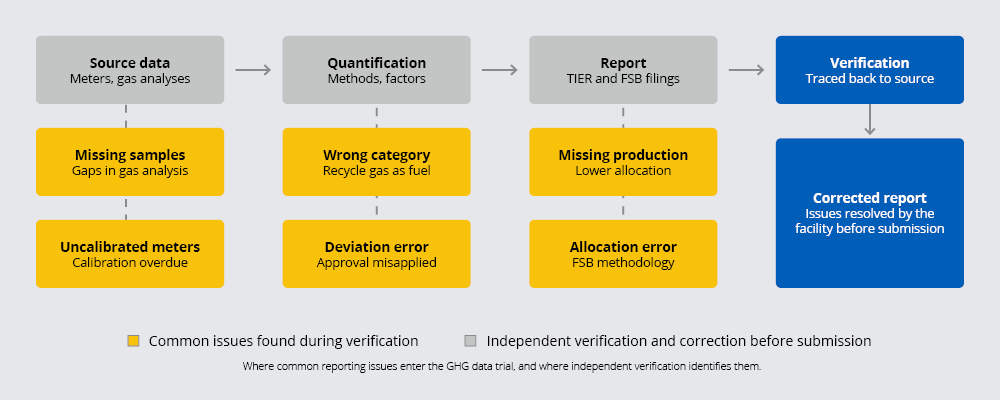
What Verification Often Reveals
Third-party verification is designed to provide independent assurance that reported emissions are complete, accurate, and prepared in accordance with applicable regulatory requirements. For natural gas processing facilities, verification frequently involves reviewing complex operational data, quantification methodologies, and supporting records.
Verification experience has shown that seemingly small issues in data collection, emissions classification, or methodology application can have a significant impact on reported emissions and compliance obligations. Examples identified during verification engagements have included:
- Classification of emissions sources: In one engagement, gas returned to the process had historically been treated as combusted fuel. Verification identified that the reported treatment was inconsistent with the facility’s operations, and the resulting correction reduced reported emissions by approximately 13,000 tCO₂e.
- Application of sampling and missing-data requirements: Verification may include assessing whether required sampling frequencies have been maintained and whether prescribed procedures have been applied when data are unavailable. In one case, missing gas composition data and associated calculation errors resulted in an understatement of approximately 7,000 tCO₂e.
- Implementation of approved quantification approaches: Where regulators approve alternative quantification methodologies, verification may assess whether the approval conditions have been interpreted and applied as intended. In one engagement, an approved deviation had been incorrectly implemented, resulting in an understatement of approximately 5,000 tCO₂e.
These examples illustrate the importance of maintaining clear documentation, robust data management practices, and a well-supported linkage between operational information and reported emissions.