
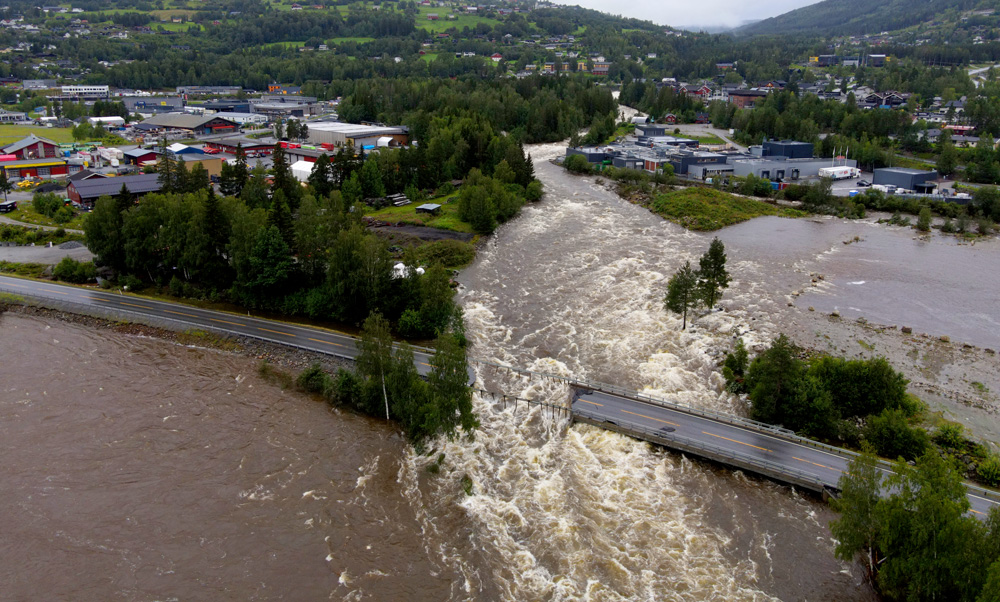
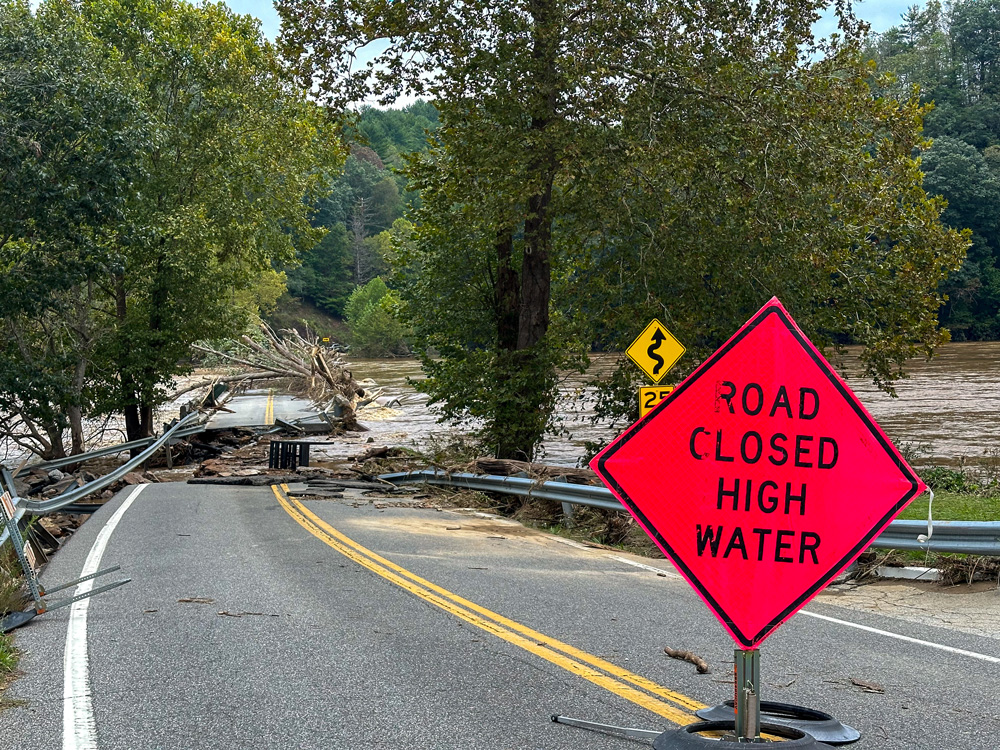
Hurricane Helene damaged or destroyed more than 1,000 bridges and culverts across the southeastern United States in 2024. Most of that damage came from water the bridges were never designed to touch: floodwater that rose past the substructure onto the bridge deck itself submerging it and exposing it to debris carried by the flow.
For nearly 40 years, bridge engineering’s flood conversation has centered on scour, which refers to what floodwater does to bridge piers. The 1987 collapse of the Schoharie Creek Bridge was a direct result of scour that undermined its piers. Inspection practices changed. Design codes changed. An entire subdiscipline of hydraulic engineering formed focused on utilizing strategies to manage how water interacts with piers.
What never got the same attention is the opposite problem: what happens when water doesn’t stay below the bridge but rises over it to partially or completely submerge the deck. As extreme flood events become more frequent and more severe that question is no longer academic. Raising a bridge so the clearance above the water is sufficient to accommodate rising floodwaters can be prohibitively expensive or impossible in some cases.
Rethinking Options
Bridge superstructures are designed to handle traffic and environmental loads such as wind and seismic forces, but not the loads imposed by floodwaters. As climate change increases the frequency and severity of flooding events, these loads are receiving greater attention. Traditionally, protecting a bridge deck from floodwaters has meant increasing the bridge elevation so that it sits safely above the highest expected water level.
That solution still works in plenty of cases but it isn’t always available. Existing roadway grades, environmental permitting, navigation clearances, construction budgets, and the infrastructure tying into either end of the bridge can all cap how much elevation is realistically on the table. For a growing number of owners, raising the bridge simply isn’t an option — which means overtopping isn’t a scenario to be designed around. It’s a load case to be included in design of both new bridges and bridge rehabilitation.
The reframing from avoidance to resistance is a bigger shift than it sounds. It means bridge superstructures need hydrodynamic force and moment data the same way they’ve long had wind-load data. Compared to the decades of research behind scour and wind engineering, hydrodynamic loading on overtopped bridge decks is still a young field, with only a handful of published studies and no codified design provisions in North America.
Borrowing From Wind Engineering to Close the Gap
RWDI and HNTB set out to test whether a proven approach from wind engineering for bridges could close that gap. Wind engineers have used aerodynamic sectional analysis for decades to determine the wind stability of long-span cable-supported bridges. They focus on measuring aerodynamic coefficients (drag, lift, and moment) on a typical section of a bridge deck in the wind tunnel. These measurements are then applied to the full bridge to predict how the actual bridge deck will perform under site conditions. It’s the backbone of how long-span bridges are designed for wind. The question was whether a similar methodology can be used to determine stability/resistance when the bridge deck is partially or completely submerged under water.
An opportunity arose to be able to test the methodology in an urban flood control project. A pedestrian bridge across a river bypass channel needed to be designed to withstand being submerged by floodwaters. The teams tested a scale model of an inclined pedestrian bridge (set at roughly a 5% grade) in both a wind tunnel and a water flume, across a range of submergence depths, channel depths, and flow speeds. The wind tunnel provided a clean baseline with no free-surface effects. The water flume reproduced the real conditions a flooded bridge would face, including a free surface that deforms as it interacts with the structure.
The result: sectional force and moment coefficients, measured on a straight section of deck, predicted the total loads on the inclined bridge with reasonable accuracy when summed along its length. That matters well beyond this one structure. It suggests overtopping isn’t a problem that needs an entirely new engineering framework — it’s one that can be approached with tools bridge engineers already trust, once the coefficients are correctly derived for water rather than air.
Five Lessons from Flood Overtopping Research
While every bridge is unique, the study revealed several insights that have broader implications for bridge design and assessment.
1. Hydrodynamic loading is not simply “more water equals more force”
One of the biggest misconceptions about overtopping is that increasing water depth simply increases loading.
The testing showed a much more complicated picture.
As water levels rise, the interaction between the bridge and the free water surface changes continuously. Drag, lift, and overturning forces vary depending on the degree of submergence, channel depth, bridge geometry, and flow velocity. During a single flood event, the forces acting on a bridge can change considerably as water continues to rise.
Design implication
Rather than evaluating a single flood condition, engineers should understand how loading evolves throughout an overtopping event. This provides a more realistic picture of bridge performance during extreme flooding.
2. The free water surface has a big influence
One of the most interesting findings came from comparing the wind tunnel and water flume results.
Under wind tunnel conditions, where the bridge was tested in unbounded flow, the bridge experienced uplift.
Under representative overtopping conditions in the water flume, that uplift became downforce because of the interaction between the flowing water and the free surface.
While this may seem like a subtle difference, it demonstrates that overtopping creates loading conditions that cannot always be predicted using simplified assumptions or data collected under different flow conditions.
Design implication
Experimental testing helps engineers better understand how bridges behave under realistic flood conditions, reducing uncertainty when evaluating overtopping scenarios.
3. Bridge geometry plays a major role
The study reinforced that there is no universal hydrodynamic loading value that applies to every bridge.
The cross section of the bridge, the level of inundation, and the characteristics of the channel all influence the forces acting on the structure. Two bridges experiencing the same flood event may respond very differently simply because their geometry interacts differently with the flow.
Design implication
Bridge-specific assessments become increasingly valuable where overtopping is possible. Understanding how geometry influences loading leads to more reliable design decisions than relying solely on generalized coefficients.
4. Testing an inclined bridge showed a more realistic loading scenario
Much of the published research on flood overtopping has focused on level bridge decks.
The bridge investigated in this study crossed the waterway on approximately a five percent grade. As water levels increased, one end of the bridge became submerged before the other, creating a constantly changing three-dimensional loading condition.
The study demonstrated that overtopping is rarely uniform across an entire structure. Different parts of the bridge may experience different loading conditions at the same point in time.
Design implication
Evaluating bridges on a grade requires engineers to consider how hydrodynamic loading changes along the length of the structure rather than assuming uniform loading across the entire deck.
5. Existing engineering approaches can be adapted
One objective of the research was to determine whether a sectional analysis approach, commonly used in wind engineering, could also be applied to overtopped bridges.
The comparison between measured loads and predicted loads showed encouraging agreement. Rather than treating flood overtopping as a completely new engineering problem, the study demonstrated that established analytical techniques can be adapted and validated for hydrodynamic loading.
Design implication
Building on proven engineering methods gives designers a practical framework for evaluating overtopping scenarios while improving confidence in bridge performance predictions.
The Part of the Problem Still Left on the Table
Static hydrodynamic loading is only part of what a flooded bridge deck experiences. Floodwater rarely arrives alone as it often carries debris. The impact and damming loads from trees, vehicles, and other debris can exceed the hydrodynamic forces on the bridge itself, a dynamic on vivid display in the aftermath of Hurricane Helene. Railings present a related design question. On some structures, allowing railings to detach in a flood event may be preferable to designing them to survive full hydrodynamic and debris loading.
As the bridge design community builds out overtopping design provisions, debris loading is the next problem that needs the same rigor.
What This Means If You Own or Design Bridges
For owners evaluating existing structures against today’s flood risk, or designers weighing whether to raise a new bridge or engineer it to withstand overtopping, a few practical conclusions follow directly from this research:
Treat overtopping as a load case, not just a failure mode
If elevation isn’t a realistic option, structural resistance to hydrodynamic loading should be evaluated explicitly, not assumed away.
Don’t borrow coefficients across flow conditions
Wind-tunnel or unbounded-flow data can misstate both the size and the direction of the load a submerged deck will see.
Ask whether your bridge‘s geometry has actually been tested
Generalized code coefficients are a starting point for screening, not a final answer for a specific, geometrically unique bridge.
Frequently Asked Questions
What is bridge overtopping?
Bridge overtopping occurs when floodwaters rises above the roadway or deck of a bridge, rather than remaining below it. Unlike scour, which attacks a bridge’s foundations, overtopping applies hydrodynamic drag, lift, and overturning forces directly to the superstructure – loads most existing bridges were never designed to resist.
Can a bridge be designed to survive being overtopped?
Yes, in principle. Research using wind-tunnel and water-flume testing has shown that sectional force and moment coefficients — the same type of data used for decades in bridge wind design — can be adapted and validated for hydrodynamic overtopping loads, giving designers a practical path to evaluate and design for the condition rather than relying solely on raising the structure.
How is overtopping different from scour?
Scour is the erosion of soil around a bridge’s piers or abutments caused by flowing water, which can undermine the foundation from below — the failure mode behind the 1987 Schoharie Creek Bridge collapse. Overtopping is a separate mechanism in which rising water applies direct hydrodynamic forces to the superstructure itself, above the waterline. A comprehensive flood-resilience assessment needs to account for both.