
Extended producer responsibility (EPR) compliance is quickly becoming a core regulatory obligation for producers operating in the United States. As more states adopt and expand EPR packaging laws, companies must navigate a growing patchwork of regulations, registration requirements, reporting obligations, and fee structures. Although compliance can be complex for organizations selling packaged goods across multiple states, staying compliant is a critical part of risk management and long-term sustainability strategy.
Packaging-focused policies in states like Colorado, Maine, California, and Oregon are reshaping how producers design, report, and finance the end-of-life management of their materials.
This guide outlines the current U.S. EPR landscape and what producers need to know to remain compliant as legislation continues to evolve.
What Is EPR Compliance and Why It Matters for Producers
EPR compliance refers to a producer’s legal obligation to manage, and finance, the end-of-life handling of the products and packaging they place on the market. Companies new to regulatory frameworks may benefit from reviewing the basics of extended producer responsibility programs before evaluating specific state requirements.
In practice, EPR compliance typically requires companies to:
- Register with the appropriate state authority or producer responsibility organization (PRO)
- Report packaging or product data annually
- Pay EPR fees based on material type, weight, recyclability, or toxicity
- Meet evolving state-specific regulatory requirements
There is currently no single federal framework governing EPR programs. Instead, producers must evaluate EPR laws by state to determine where compliance obligations apply based on scope of the program, product categories, sales activity, and distribution footprint.
Understanding how EPR regulations apply to your business is the first step toward reducing risk and building a streamlined, multi-state compliance approach.
Packaging Extended Producer Responsibility Laws by State
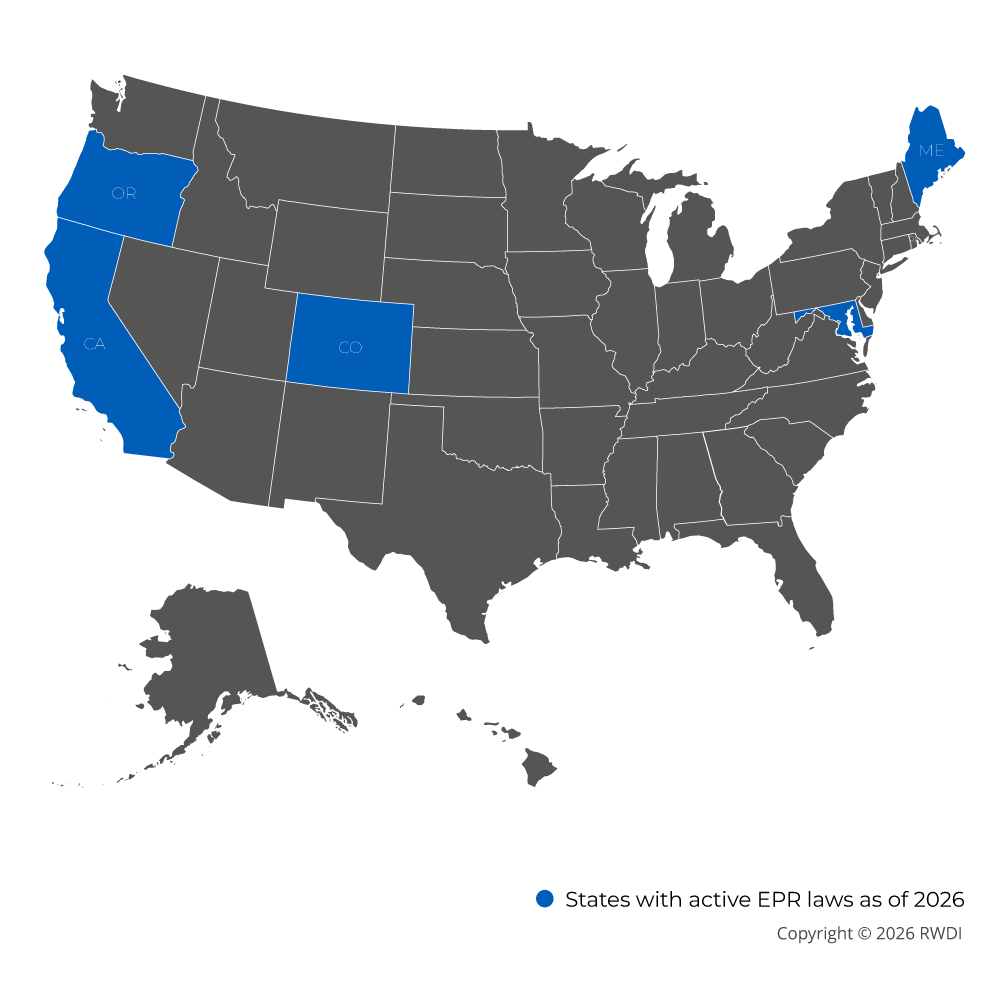
Currently, several states have enacted packaging extended producer responsibility laws. These laws cover a wide range of materials, including packaging, paint, electronics, batteries, mattresses, and pharmaceuticals. More recently, packaging-focused EPR laws have introduced new registration, reporting, and fee requirements for companies selling packaged goods into those markets.
The following programs are in different stages of implementation.
Key states include:
- Maine – First U.S. packaging EPR law, establishing a packaging stewardship program for municipal recycling reimbursement.
- Oregon – Recycling Modernization Act expanding recycling services and creating producer-funded infrastructure investments.
- Colorado – Producer Responsibility Program requiring packaging producers to fund statewide recycling services.
- California – Senate Bill 54 requiring packaging reduction, recyclability standards, and producer funding for recycling systems.
- Maryland – Recently adopted framework establishing a statewide packaging EPR program currently under development.
The sections below outline how each state program works and what producers must do to meet requirements.
California Plastic Pollution Prevention and Packaging Producer Responsibility Act (SB 54)
California’s Senate Bill 54, known as the Plastic Pollution Prevention and Packaging Producer Responsibility Act, established one of the most comprehensive packaging EPR programs in the United States.
The law applies to single-use packaging and plastic food service ware and requires producers to fund recycling systems and reduce plastic waste statewide.
In addition to producer funding requirements, SB 54 establishes major sustainability targets. The law requires that all packaging in California be recyclable or compostable by 2032, Producers must also ensure their plastic packaging meets increasing recycling rates: 30% by 2028, 40% by 2030 and 65% by 2032.
California regulators, including CalRecycle, oversee the program and provide detailed guidance on how packaging materials are categorized and reported.
Key requirements for producers include:
- Participating in a Producer Responsibility Organization approved by CalRecycle
- Reporting packaging materials introduced into the California market
- Contributing program fees that fund recycling system improvements and environmental mitigation efforts
- Meet source reduction targets and recycling goals mentioned below
- Developing and submitting an individual plan to meet source reduction targets
Colorado Packaging EPR Law
Colorado established its packaging EPR law through the Producer Responsibility Program for Statewide Recycling Act (HB22-1355). The law requires producers of packaging and paper products to fund and support a statewide recycling system.
Under the program, producers must participate in a Producer Responsibility Organization (PRO) that manages recycling services, program funding, and compliance reporting. The state appointed Circular Action Alliance as the official PRO responsible for administering the program.
As of July 1, 2025, companies cannot sell or distribute products with covered packaging in Colorado unless they participate in the producer responsibility program or operate under an approved individual compliance plan.
The full program implementation is expected to launch in 2026.
Key requirements include:
- Producers must register with the PRO and report packaging data
- Annual producer responsibility fees fund recycling infrastructure
- The PRO must reimburse 100% of net recycling costs for participating recycling providers
- A statewide minimum recyclable materials list determines covered materials
- Recycling rate and post-consumer recycled content targets are established for 2030 and 2035.
Maine Packaging Stewardship Program
Maine was the first U.S. state to pass a packaging EPR law, in 2021. The law shifts the cost of municipal recycling systems from taxpayers to the producers of packaging materials.
The program is operated by a state-selected stewardship organization, which manages compliance reporting, fee collection, and program operations, while the Maine Department of Environmental Protection provides regulatory oversight.
Rules for the program were finalized in 2024, with full implementation expected by 2027.
Under Maine’s program:
- Producers must report packaging material placed on the market in Maine
- Companies must pay fees into a packaging stewardship fund
- Payments are based on packaging volume and recyclability
- Funds are used to reimburse municipalities for recycling costs and invest in recycling infrastructure.
Oregon Recycling Modernization Act
Oregon’s Recycling Modernization Act (SB 582) introduced an EPR framework designed to expand recycling access and improve recycling system performance statewide.
Under the law, producers of packaging, including transportation packaging, along with printing and writing paper, must fund recycling services through participation in a producer responsibility program.
The program also introduces eco-modulated fee structures, meaning producer fees may vary depending on the recyclability and environmental impact of packaging materials. Oregon’s program also establishes a statewide list of recyclable materials, helping standardize recycling acceptance across the state.
Key requirements for producers include:
- Registering with the approved Producer Responsibility Organization
- Reporting packaging materials supplied into the Oregon market, including material types and weights
- Paying program fees that help fund recycling collection, processing, and infrastructure improvements
Maryland Packaging EPR Law (SB 222)
Maryland joined the growing list of states adopting packaging EPR with the passage of Senate Bill 222, which establishes the framework for a producer responsibility program.
The law directs the state to develop a system where packaging producers help fund recycling and waste management services.
Implementation details and regulatory rules are being developed to operationalize the program in the coming years.
Key requirements include:
- Creation of a producer responsibility organization
- Producer registration and packaging reporting
- Development of a statewide recycling plan
- Cost-sharing mechanisms to support municipal recycling systems
How Packaging Producers Can Prepare for EPR Compliance
Taking a proactive approach to compliance can help companies avoid disruptions and minimize regulatory risk. Many organizations are also turning to organizations that offer EPR Compliance Services to help them navigate the evolving regulatory requirements across multiple jurisdictions.
The following steps can help producers begin preparing a plan to meet packaging EPR compliance requirements.
-
Identify Whether Your Company Qualifies as a Producer
Under most packaging EPR laws, the term producer refers to the entity responsible for placing packaged products on the market in a given state. This may include:
- Brand owners selling packaged goods
- Importers introducing packaged products into the U.S. market
- Private label retailers selling store-brand products
- Manufacturers selling products without a brand owner
Because definitions vary by state, companies should review each program’s legal definition of a producer to determine whether they fall within scope.
-
Evaluate Packaging Materials and Covered Products
Packaging EPR programs apply to specific categories of packaging and paper products. Producers must identify which materials fall under each state’s definition of covered materials, which may include:
- Primary product packaging
- Secondary or grouped packaging
- Shipping and transport packaging
- Single-use food service ware
- Certain paper products
Conducting a packaging inventory helps companies determine what materials must be reported and whether those materials meet recyclability requirements established by state programs.
-
Register With a Producer Responsibility Organization
Most U.S. packaging EPR laws require producers to join a Producer Responsibility Organization (PRO). The PRO manages the operational aspects of the program, including:
- Producer registration and compliance reporting
- Packaging data collection and verification
- Fee administration
- Funding of recycling systems and infrastructure
In several states, Circular Action Alliance has been selected to serve as the PRO responsible for implementing packaging EPR programs.
-
Establish Internal Packaging Data Tracking
Accurate data reporting is a core component of EPR compliance. Producers are typically required to report the amount and type of packaging materials sold into each regulated state.
Companies should begin developing systems to track:
- Packaging material types (e.g., plastic, paper, metal, glass)
- Packaging weights and formats
- Sales volumes by state
- Recyclability characteristics of packaging materials
Building internal data tracking processes early can help reduce reporting challenges as programs move into active compliance phases. Many companies work with specialists that support packaging EPR reporting and compliance management to streamline data collection and ensure accurate regulatory submissions.
-
Monitor Implementation Timelines and Regulatory Updates
Many packaging EPR laws are still in the rulemaking and implementation stages. As a result, compliance deadlines, reporting requirements, and fee structures may evolve over time.
Producers should regularly monitor updates from:
- State environmental agencies
- Producer responsibility organizations
- Official EPR program websites
Staying informed about regulatory developments helps ensure companies remain compliant as programs transition from planning phases to full implementation.
Final Thoughts
Packaging extended producer responsibility laws are rapidly reshaping how recycling systems are funded and managed across the United States. As more states adopt packaging EPR programs, producers are increasingly responsible for the environmental impacts of the packaging they introduce into the market.
Because these regulations operate on a state-by-state basis, companies must carefully evaluate where their products are sold and determine which packaging EPR laws apply to their operations. Differences in registration requirements, reporting timelines, fee structures, and PRO participation mean that compliance can quickly become complex, especially if operating across multiple jurisdictions.
Organizations that establish strong data management and compliance strategies today will be better positioned to adapt to future regulatory developments and support more sustainable packaging systems. Working with sustainability and regulatory specialists can help producers streamline EPR compliance and ensure alignment with evolving state requirements, turning compliance into a more manageable and strategic part of their sustainability efforts.