Originally published: August 2023
Last updated: May 2026,
Parking garage ventilation is an essential consideration for building designers, engineers, and developers, not just for meeting code, but for protecting occupant health, controlling long-term operating costs, and delivering a high-performing built environment.
Whether you’re integrating underground parking into a mixed-use development or designing a freestanding parking structure, a well-engineered parking garage ventilation design is one of the most consequential decisions made early in a project. Here is why effective ventilation matters and the top strategies for implementing the most efficient and cost-effective system.
Why Is Improving Ventilation Effectiveness Vital in Parking Garage Design?
Air pollutants in an enclosed space, such as a parking garage, can negatively impact human health fast – faster than many believe. Parking garage ventilation systems play a vital role in controlling the environment inside the garages and ensuring the safety of those who use them. Insufficient parking garage ventilation can fall short of building codes, negatively impact human health, and increase project costs.
Here are the top reasons why building designers should prioritize ventilation effectiveness from the earliest design stages.
Building Code Compliance
Building regulations contain specific requirements that must be met. Naturally ventilated parking garages must meet strict criteria for the areas and arrangements of openings, and mechanically ventilated systems must provide minimum quantities of fresh air. While meeting the building code requirements can achieve adequate ventilation in most cases, specific parking garage designs may still have some stagnant, under-ventilated areas that only detailed analysis can identify.

Impact on Occupant Health and Air Quality
Parking garage air quality is a direct occupant health issue. Garages can experience exhaust gas buildups when ventilation is insufficient, putting users and staff at risk. The most significant of these are carbon monoxide (CO) and nitrogen dioxide (NO₂). Proper CO monitoring in parking garages, integrated with demand-controlled ventilation, is one of the most effective ways to protect occupants while avoiding unnecessary energy use but a designer needs to understand where the buildup is most likely to occur to limit occupant risk.
Achieve Long-Term Cost Savings
When planned properly, effective parking garage ventilation design creates meaningful cost savings, reducing both equipment and energy costs over the life of the building. A ventilation modeling analysis may reveal, for example, that a smaller fan can match the performance of a larger one in a given space, reducing upfront equipment cost. Modeling can also identify more effective fan placement locations and account for variations in activity level.
This could quantify the potential for reduced energy consumption if exhaust systems are designed to activate on demand — triggered by CO and NO₂ sensors — rather than running continuously. In an office building parking garage, for instance, peak traffic periods like morning and evening rush hours drive ventilation demand, while midday periods do not.
Comparing Natural Ventilation and Mechanical Ventilation for Parking Structures
For above ground parking garages, building designers typically have several parking garage ventilation systems available:
- Natural ventilation (if sufficient openings to outdoors can be provided)
- Continuous mechanical ventilation (potentially with standby and high flow modes using CO and NO2 sensors)
- A combination of natural and mechanical ventilation: On-demand mechanical ventilation by means of CO and NO2 sensors
Underground or enclosed parking garages must use continuous mechanical ventilation, as natural ventilation would fall short of building codes and standards.
Natural Ventilation
Natural ventilation harnesses differences in air pressure inside and outside a structure through wind forces and stack effect, to deliver clean air and clear pollutants. It is highly dependent on building design and site conditions. How exterior openings are distributed relative to prevailing wind directions, the use of decorative screens, and the proximity of neighbouring buildings all influence performance. For many urban parking structures, natural ventilation alone is insufficient, making mechanical ventilation for parking structures necessary.
Mechanical Ventilation
For most parking garages, mechanical ventilation for parking structures involves the installation of exhaust fans that extract stale air and induce fresh outdoor air through direct openings, plenums, ducts, or ventilation wells. The layout of ventilation openings is critical in determining whether all areas of a parking garage are adequately served. A layout that hasn’t been thoroughly analyzed can result in poor air quality post-construction — leading to costly retrofits and corrective measures that could have been avoided with upfront modeling.
Engineering Strategies for Effective Ventilation in Parking Garage Design
Effective parking garage ventilation design often means going beyond prescriptive code compliance to mitigate health impacts and optimize long-term performance. The most effective approach combines two analytical tools in the early design stages, for both new builds and garage renovations.
Pollutant Emission Modeling
Pollutant emission modeling is an incredibly useful tool to provide informed input parameters for parking garage ventilation design. It works by developing a bespoke estimate for peak traffic flow conditions, that is, the number of cars starting, idling, and queueing in the parking garage. The model considers how the emission rates are affected by the local climate and the local mix of vehicle types. These are combined to determine how much pollutants vehicles are emitting into the air in computational fluid dynamics (CFD) simulations.
This step is often skipped in favour of prescriptive design, but it is precisely what allows engineers to right-size ventilation systems, avoid over-engineering, and validate that code-minimum designs will perform as intended under real-world conditions.
CFD Parking Garage Simulations
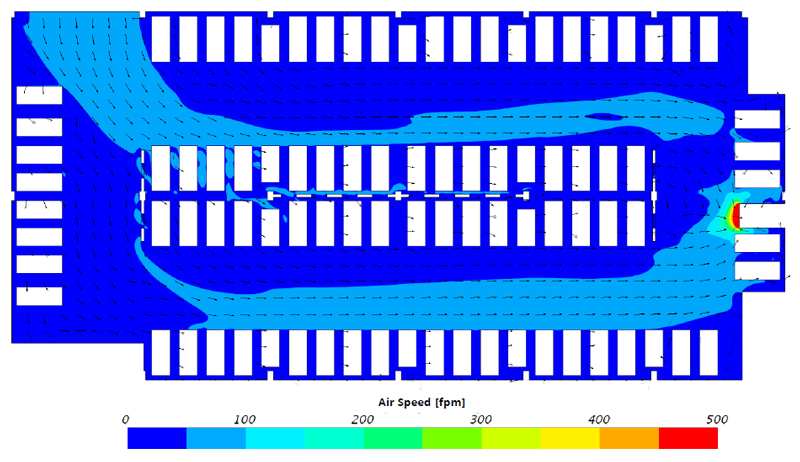
The analysis can range from a Computational Fluid Dynamics (CFD) simulation of just air movement inside the parking garage to more complex models that include both the parking garage mechanical system and the impacts of site-specific wind conditions. CFD simulations can provide details on air quality distribution within the garage, thus revealing opportunities to boost effectiveness, such as placing fans and air vents in strategic locations to better circulate and ventilate the garage.
These simulations can also track the path of air pollutants, show how they are to flow through the garage, and calculate the concentration distribution of key pollutants. In the case of carbon monoxide, the simulation can identify how quickly CO can build up to an unsafe concentration.
CFD is also capable of analyzing a parking garage’s ventilation system and evaluating its performance. It can help generate the performance data required by regulatory bodies for atypical designs and improve the layout of vents, fans, and exhausts.
Moving Forward with Effective Parking Garage Ventilation
A well-designed parking garage ventilation system provides fresh air, flushes contaminated air, protects occupant health, and delivers long-term energy and equipment cost savings — but only when it is engineered with the right tools from the start.
For building designers and developers, the key is integrating pollutant emission modeling and CFD parking garage simulation early in the design process, when changes are least costly and opportunities to optimize are greatest. Relying solely on prescriptive code compliance leaves performance on the table and exposes projects to the risk of costly post-construction corrections.
RWDI’s building science and ventilation engineering team works with designers and developers to model, analyze, and optimize parking garage ventilation systems from concept through construction. Get in touch to discuss your project.