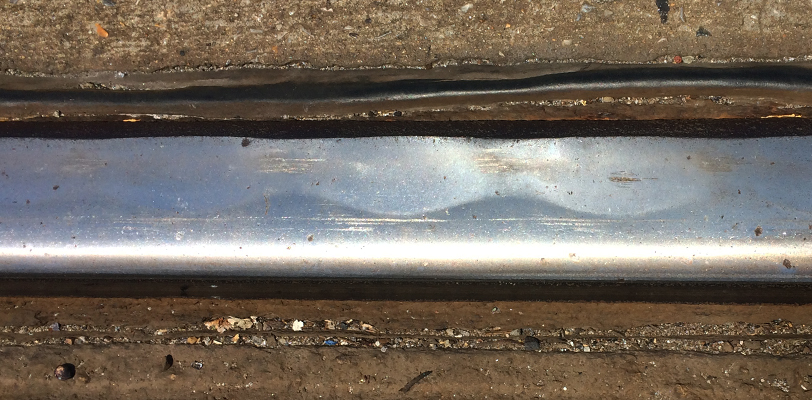
There is a particular kind of infrastructure problem that doesn’t make headlines until it’s too late. It accumulates slowly, cycle by cycle, train by train, until one day a maintenance team is staring at a length of rail that looks less like steel and more like a washboard, and the cost of repairing it is significantly larger than anyone budgeted for.
This is known as rail corrugation. For transit agencies and rail operators facing aging infrastructure, growing state of good repair backlogs, and constrained capital budgets, it represents one of the most significant and least understood threats to long-term asset performance.
The State of Good Repair Challenge Facing North American Rail
Much of North America’s urban rail infrastructure was built during a period of significant public investment that stretches from the postwar era through the transit expansion of the 1970s and 80s. The subway lines, light rail corridors, and commuter rail networks that millions of people rely on every day were designed with a service life in mind. Many of those timelines have already been exceeded.
The result is a sector-wide reality that operators know all too well, the state of good repair backlog. Before any new expansion is on the table, before any capital programs for extending a line or adding stations are announced, there is the pressing work of keeping existing systems running, and the margin for error gets narrower every year.
With this in mind, how operators decide to manage wear and tear becomes a strategic decision. Every dollar spent on reactive repair is a dollar not available for proactive investment. Every unplanned service disruption erodes rider confidence. Every deferred maintenance decision that compounds into a larger failure represents a cost that the original budget never anticipated. As a result, there is a pressure to extend the life of infrastructure and make it perform reliably into the next era.
What is Rail Corrugation?
Rail corrugation refers to the periodic, wave-like roughness that develops along the running surface of a rail. This phenomenon is often introduced to the public as a noise issue. Riders notice it as rhythmic rumbling or squealing, and regulators sometimes flag it against environmental noise criteria. While these are real concerns, they are actually symptoms of a much deeper mechanical problem.
Corrugation is the product of complex dynamic interactions between the wheel and the rail. As a train moves, the contact between wheel and rail generates oscillating forces. Over time and under certain conditions, those forces create and reinforce undulations in the rail surface at specific wavelengths. Once established, corrugation is self-reinforcing, the rougher the rail surface becomes, the more severe the dynamic forces, which accelerates the growth of the corrugation pattern. Left unaddressed, this feedback loop produces rapidly escalating damage to the broader track system, the rolling stock, and the underlying infrastructure.
Why Rail Corrugation Keeps Coming Back
Rail grinding is often the method chosen to address rail corrugation. It restores the rail profile temporarily, and while it remains an essential maintenance tool, it does little to explain why corrugation formed in the first place, how quickly it is growing, or when it is likely to return.
The warning signs of rail corrugation are measurable long before significant damage occurs. Changes in vibration signatures, shifts in noise profiles, and detectable variations in rail deflection are all indications that corrugation is occurring. The challenge is recognizing and interpreting those signals before they become costly maintenance problems.
This gap is critical in how many operators approach corrugation. Too often, it is treated as a maintenance event to be scheduled and executed rather than a condition that should be predicted, monitored, and managed throughout the railway’s lifecycle. The process begins during the design of new or upgraded railways, where advanced modelling can identify locations that are susceptible to adverse wear, including corrugation.
During operation, ongoing monitoring helps:
- Detect emerging corrugation
- Validate model predications
- Identify changes in wheel-rail behavior, vehicle characteristics, and track conditions
Maintenance interventions, such as rail grinding, then become the final step, targeting the underlying problem rather than simply reacting to its symptoms. Without this lifecycle approach and an understanding of the wheel-rail dynamics driving corrugation growth, the same wear patterns often reappear on the same timetable, or even sooner if operating conditions have changed. In some cases, the causal mechanism can be directly traced to specific track support arrangements, or the inclusion of vibration attenuation measures incorporated into the track system.
Extending Rail Asset Life Through Better Wheel-Rail Insights
Few maintenance decisions carry greater financial consequences than deciding when a rail asset should be maintained, rehabilitated, or replaced. The decision of when to replace rather than maintain is one that carries enormous financial consequences. Get it wrong in one direction and you’re replacing rail that had serviceable life remaining. Get it wrong in the other direction, and you’re running degraded infrastructure that is causing damage to other components at a rate that drives total lifecycle costs higher than any preventive program would have cost.
The path to extending asset life isn’t simply grinding more frequently. It requires an understanding of the following:
- Corrugation growth rates for a given section of track
- Relationship between growth rates and rolling stock operating on that corridor
- Influence of track geometry and rail cant
- Track support and fastner systems
Advanced wheel-rail interaction analysis can model the energy in the wheel-rail contact zone, quantify the dynamic excitation that drives corrugation, and forecast corrugation growth rates under varying operational conditions. This kind of modeling, combining multibody vehicle dynamics with vibro-acoustic analysis, allows operators to make maintenance decisions based on predicted performance rather than observed degradation.
The difference in outcomes is significant. Proactive maintenance intervals calibrated to actual corrugation growth rates consistently extend the period between grinding cycles, reduce the severity of corrugation at each intervention, and reduce the cumulative damage to the track system over time. The rail lasts longer. The wheels last longer. The track components that bear the load of every passing train last longer.
From Inspection to Prediction: Closing the Rail Monitoring Gap
Traditional inspection regimes provide snapshots. They tell you the condition of the rail on the day of the measurement. They do not tell you how quickly it is changing, what is driving that change, or where in the network the next problem is likely to emerge.
Instrumentation systems that monitor vibration signatures, rail roughness profiles, and noise emissions in real time can detect the early stages of corrugation growth before they reach a severity that requires intervention. Early detection means earlier, lighter intervention, less material removed per grinding pass, longer intervals before the next pass is needed, and more precise targeting of maintenance resources to the sections of track where they will have the greatest impact.
Custom wheel and rail monitoring systems and protocols that allow early detection of noise and vibration performance changes are a proven methodology for planning maintenance interventions more effectively. When those monitoring data are integrated with predictive models of corrugation growth, operators move from a reactive position to a more proactive one. The track is maintained to a consistent performance standard, the asset degradation curve is flattened, and the gap between current condition and end-of-life condition widens rather than narrows over the service life of the system.
A Smarter Approach to Rail Corrugation Management
The transit operators and rail engineers who are navigating the challenges mentioned above most effectively are not the ones with the largest maintenance budgets. They are the ones who know where the corrugation risk is highest, what the growth rates look like for their specific wheel-rail combinations, and how to sequence their maintenance interventions to maximize the return on every dollar spent.
North America’s rail infrastructure is not going to be replaced in a single capital program. The systems that exist today need to keep running while the political and financial conditions for renewal are assembled over years and decades. In that context, every month of additional reliable service life matters. Every maintenance dollar that is deployed intelligently rather than reactively compounds over time into a system that is more resilient, better understood, and more defensible when the moment for larger investment finally arrives.
Rail corrugation is a preventable problem at design stage and a solvable problem during operations. But solving it sustainably requires treating it as the engineering challenge it actually is, a fundamental dynamic interaction between rolling stock and infrastructure that, managed well, is one of the most powerful levers available for extending the life of assets that communities depend on every day.