Historic buildings have stood the test of time, and with proper maintenance, they can continue to serve future generations. Often constructed with high-quality materials and skilled craftsmanship, they were thoughtfully designed to maximize natural light and airflow. They are also adaptable to a variety of contemporary uses.
But, effective strategies for maintaining historic buildings is ever changing. Climate change has created new and changing threats to historic buildings. From temperature changes to increased rainfall expanding the risk of flooding, historic and heritage organizations, governments, and property owners alike need to pay attention. The natural deterioration of historic buildings due to weathering happens over time. However, the changing climate and its effects have:
- increased the intensity of challenges facing historic buildings,
- presented new challenges, and
- increased the urgency to engage in effective management of historic building in the face of climate change.
Maintaining a historic building requires more than just routine upkeep, it demands a thoughtful approach that accounts for long-term resilience, environmental challenges, and evolving performance needs.
To help you future-proof your property while preserving its character, here are six strategies from climate and performance engineering specialists to consider adding to your building maintenance plan:
1. Assess Long-Term Climate Risks to Protect Your Building’s Future
Historic buildings weren’t built with today’s climate in mind. Increased rainfall, flooding, extreme heat, and modern air pollution all pose unique threats to aging structures. Without proper adaptation, these environmental stressors can lead to faster deterioration, mold, and structural damage.
Climate risk assessments examine trends in the local climate to help predict future weather patterns and events. They are critical for improving the climate resilience of historic buildings. These assessments help decision-makers like property owners understand, adapt, and effectively mitigate the risks and impacts to historic buildings based on changes in the climate, such as an increased frequency of high wind events.
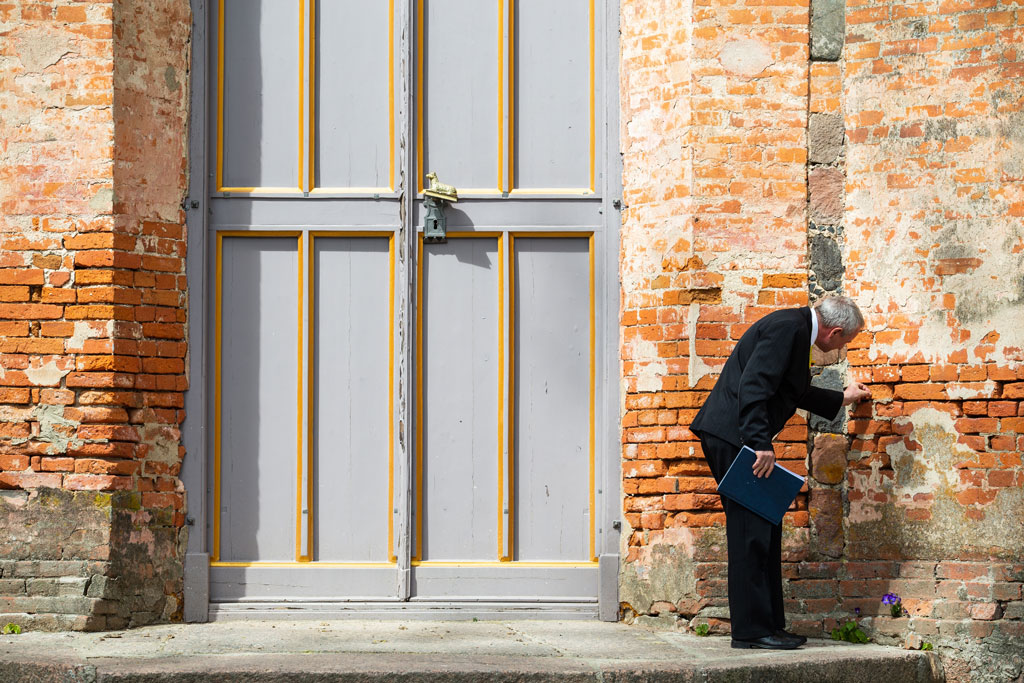
Assessments can go beyond preserving the physical structure of a building and help improve the habitability of historic buildings. A professional climate assessment can provide insights into areas like temperature and humidity within the building. This enables owners to make necessary adjustments that ultimately improve both visitor and resident comfort. Such adjustments are crucial, especially when it comes to preserving assets contained within the building, like historical artwork.
Climate assessments serve as significant support in improving the resilience of historic buildings against a changing climate. This is largely due to their ability to assist in the prioritization of the most appropriate investments. Ultimately, they allow property owners to transition to a proactive strategy from a reactive response.
Understanding future climate scenarios is a crucial step in identifying the adaptations historic buildings can undertake to protect themselves, even when dealing with architectural constraints in place to maintain the historic fabric of the building.
2. Increase Operational Efficiency Through Targeted Energy Retrofits
Improving the energy efficiency of historic buildings doesn’t mean sacrificing their character or architectural integrity. In fact, poorly planned retrofits in past decades often did more harm than good—shrinking windows, covering high ceilings, or stripping away original plaster, all in the name of efficiency. Ironically, these changes often increased energy demand by reducing natural light, ventilation, and insulation.
Today, building science and thoughtful engineering offer better solutions. Energy retrofits can be tailored to historic buildings using strategies like:
- Retaining Original Features: Properly maintained historic windows, when weatherized, can perform nearly as well as replacements—without the environmental and aesthetic costs of vinyl or aluminum alternatives.
- Restoring Passive Strategies: Reopening transom windows or selective removal of dropped ceilings can restore airflow and daylighting, reducing HVAC and lighting loads.
- Preserving Insulating Materials: Original plaster on brick walls adds insulation and protects structural elements—removing it can reduce energy performance and cause damage.
The assessments that make up the energy retrofit process analyze what can be done to improve a historic building’s energy efficiency and achieve cost savings without significantly impacting its historic fabric.
Every building is different, which is why energy retrofit assessments are crucial. They help identify opportunities to enhance comfort, indoor air quality, and efficiency—while respecting the building’s historic fabric.
3. Use Weather Forecasting to Make Informed Maintenance Decisions
Instead of reacting to severe weather events after they have happened, weather forecasting opens the opportunity to prepare for extreme weather and determine the appropriate actions that must be put in place to minimize potential damage to the building and its contents.
With historic buildings that have outdoor spaces, weather forecasting provides insights that allow stakeholders to make informed decisions on day-to-day operations that can significantly assist with historic building planning.
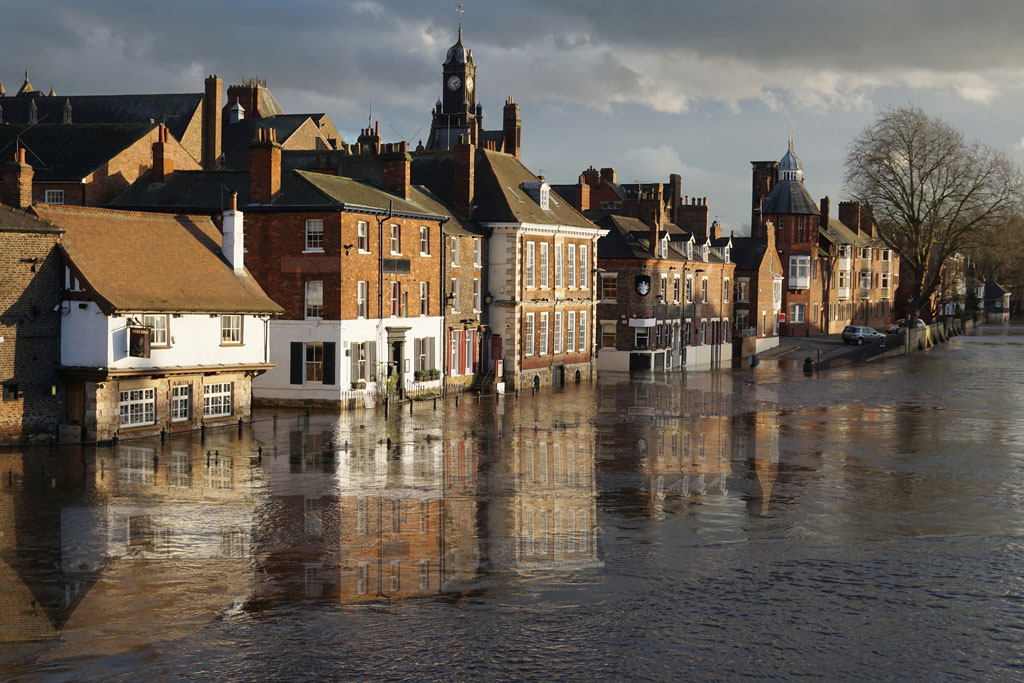
Forecasts can also detect extreme temperatures, both high and low. This can help with decision-making to mitigate power outages due to high power demand. They can also reveal what building materials, if any, may experience issues because of these extreme temperatures. This provides an additional opportunity to put mitigation strategies in place.
Why Weather Monitoring Matters:
- Prevent Damage Before It Happens: Forecasts allow owners to anticipate and act on severe weather events—floods, heatwaves, heavy winds—before they cause irreversible damage.
- Plan Smarter Day-to-Day Operations: Real-time insights help guide decisions for properties with outdoor features, allowing staff to protect exposed materials or close access areas as needed.
- Protect Vulnerable Materials: Monitoring temperature and humidity can help prevent deterioration of historic wood, metal, or plaster, and reduce stress on aging HVAC systems.
With weather monitoring as part of a broader resilience strategy, historic property owners can protect both the structure and the cultural value of their buildings for future generations.
4. Adopt Performance-Based Design for Smarter Interventions
Historic buildings were often built with a deep understanding of local climate, material behavior, and passive comfort strategies, long before energy codes existed. In fact, some perform better today than much newer buildings, thanks to thoughtful orientation, durable materials, and natural ventilation. However, as conditions change—climate, occupancy patterns, and performance expectations—it’s important to assess how a building is functioning now, and where strategic upgrades could support its longevity and livability.
Performance-based design offers a flexible, context-sensitive approach. Rather than forcing historic buildings into rigid compliance with modern code requirements, this method evaluates how a building performs across key metrics—such as thermal comfort, durability, air quality, and energy use— and identifies targeted improvements that preserve character while enhancing resilience, safety, and comfort.
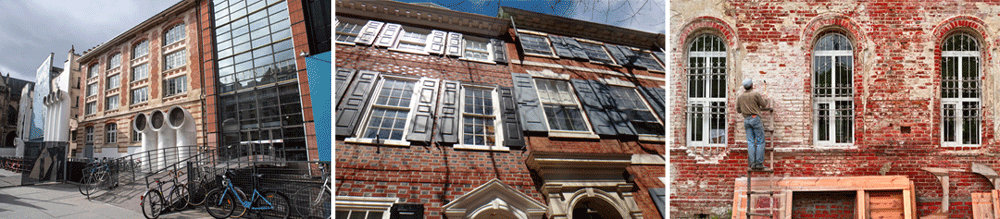
A performance-based assessment helps identify where interventions are most needed and how to carry them out without compromising the building’s integrity. Key areas to consider include:
Ventilation Adjustments
Adjusting ventilation in a historic building, whether natural or mechanical, will help combat the extreme heat that is becoming increasingly more common due to climate change. Some historical buildings may have low ceilings or limited space to run ductwork, making proper ventilation challenging.
Many historic buildings were designed to breathe using passive ventilation, operable windows, and cross-ventilation to maintain comfort. As climates shift and internal loads (like electronics or insulation) change airflow dynamics, computational fluid dynamics (CFD) modeling can help refine ventilation strategies. CFD analyses can assist with concepts and the development of ventilation systems that can fit in tight spaces. Whether supplementing natural airflow or introducing discreet mechanical systems, the goal is to enhance comfort without disrupting original architecture.
Focus on Insulation
Upgrading thermal performance requires careful analysis. Some historic glazing or wall assemblies may already perform adequately, especially in milder climates or with low internal moisture loads. Where improvements are necessary, such as addressing condensation or heat loss, tools like hygrothermal modeling can help design compatible solutions that manage moisture, protect original materials, and improve occupant comfort.
Adding insulation to an existing wall changes how the wall responds to heat, water and water vapor. Interior heat will no longer drive moisture out. The wall gets colder and wetter. This can lead to: increased risk of freeze thaw damage to the masonry; increased risk of salt crystallization damage; potential for rot if there is embedded wood structure; potential for rust if there is embedded steel structure.
The bottom line? A site-specific analysis before insulating older walls will help you understand how the wall works as a system and will be key to avoiding long-term damage.
Optimize Façades
Air leakage and uncontrolled moisture ingress can affect comfort and durability, regardless of a building’s age. Leaky façades in historical buildings specifically can present:
- adverse stack effect issues,
- lower occupant comfort, and
- hasten the degradation of the building’s interior.
A targeted envelope assessment can help determine whether and where performance gaps exist. Where needed, sensitive repairs or air sealing can improve thermal performance while preserving exterior character and materials.
5. Reduce the Impact of Vibration on Historic Materials and Structures
The local conditions of the site, building materials, construction quality, natural erosion, and several other risk factors can cause a vibration issue with historic buildings. This can happen when they are combined with vibration from construction or seismic action.
Here are two strategies historic building projects can employ to mitigate vibration:
Testing and Monitoring
Testing and vibration measurements help establish the baseline vibration conditions of a historic building. They can also continuously monitor the “health” of a building’s structure. Testing helps make accurate projections of what risks vibration activity could pose, while continuous monitoring triggers an alert when vibrations exceed a specified limit.
When it comes to protecting historic buildings from earthquake-induced vibrations, testing and monitoring are once again key. Following this approach can reveal the most effective and appropriate mitigation options. Among these can be seismic isolation systems as well as dampers implemented during a historic building retrofitting process.
Base Isolation
Base isolation technologies have been traditionally used to improve the seismic performance of buildings and other large structures, like bridges. However, in recent years the application of base isolation has been gradually extended to the seismic protection of museum artifacts. Installing base isolation systems beneath showcases or sculptures displayed inside or outside museums effectively protects important and irreplaceable cultural properties and artworks.
Ultimately, different vibration levels will affect different historic buildings in varying ways. This is precisely why a one-size-fits-all solution for reducing the effects of vibration isn’t appropriate. The unique nature of the buildings being protected requires the development of suitable bespoke approaches. Examples of these approaches can span from adding isolators to safe working zones and techniques.
6. Integrate Sustainable Practices into Your Restoration Approach
Integrating sustainability into the restoration process not only supports environmental goals but also helps position historic buildings for long-term success.
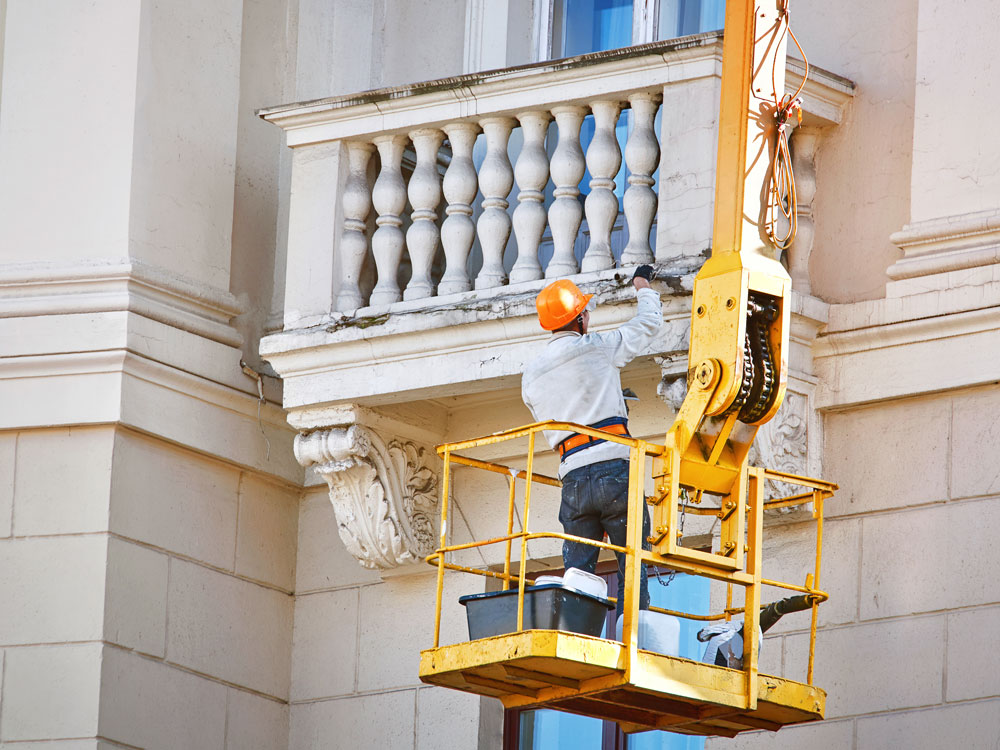
In 2015, the Green Building Council Italia published the GBC Historic Building certification, a protocol aimed at the sustainable restoration of historic buildings. This protocol is the first of its kind, though there are already efforts underway to extend its use to other countries in Europe. It recognizes that the unique nature of historic buildings requires a different approach than those taken with modern buildings. It also positions sustainable restoration as another form of protection for historic buildings, not a change in their original intent.
The protocol’s energy and atmosphere category is among the innovative aspects that frame sustainable restoration in this way with the energy efficiency and retrofit process. It also presents a dual approach to indoor environmental quality, balancing the conservation of the architecture of historic buildings with achieving the highest indoor air quality and comfort.
Ultimately, this protocol builds on the growing notion and evidence that resilient restoration can dramatically increase the overall longevity of historical buildings.
The Future of Historic Buildings
Effective protection efforts mean taking a proactive approach and conserving the beauty and condition of the historic buildings as much as possible, while placing less emphasis on reactive responses to repair damage after it occurs.
To recap, here are the 6 strategies that building science engineers recommend for historic buildings:
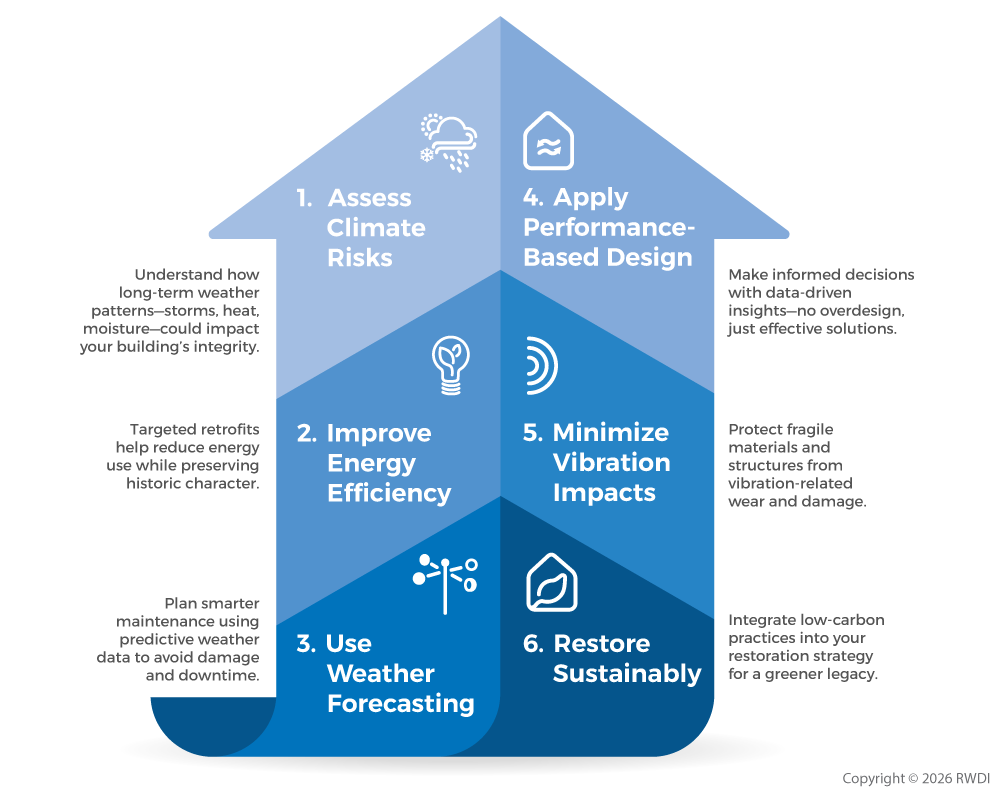
Because of the changing climate, historic property owners need to employ a combination of strategies to maintain historic buildings, from weather forecasting and climate assessments to sustainability. Every building and every climate is different. Maintaining a historic building is about more than honoring the past, it’s about preparing for the future. By applying building science and thoughtful engineering, property owners can improve energy efficiency, adapt to a changing climate, and protect these structures from weather-related damage without compromising their historic character.
With the right assessments, materials, and strategies in place, your building can stand strong for generations to come both as a cultural asset and a comfortable, resilient space.